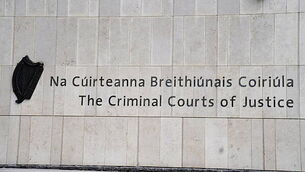
Family of woman who died in St Vincent's Hospital settle High Court action

High Court Reporters
“Her loss has left a hole in our hearts that will never heal.”
These are the words of the family of a mother of four who died at St Vincent’s Hospital, Dublin, after it was claimed that a critical blood count result, which would have alerted doctors to a significant bleeding having occurred, was not discovered for seven hours.
The hospital’s systems analysis review later concluded that had the abnormal blood test result been acted upon when processed, it is likely the cardiovascular collapse of Ellis Cronin Walsh, who was recovering from surgery at St Vincent’s, would have been avoided.
Eilis Cronin Walsh (49) from Ballina, Co Mayo died at St Vincent’s Hospital, Dublin on October 17th, 2021.
Eilis’s son, Kevin, flanked by his father, James and brother Kyle, outside the Four Courts, said their family is no longer whole after her death.
“We speak today not just for our own grief, but so that no other family has to endure what we have. We honour her memory, and we demand accountability. Eilis’s life mattered. Her story must be heard. Her death must lead to change,” he said.
In the High Court on Wednesday, Eilis’s husband, James Walsh, settled an action against the hospital over her death.
The family’s counsel, Joe Brolly BL, instructed by David O’Malley, solicitor, told the court the family are deeply agonised by Eilis’s death,
He said St Vincent’s Hospital had made a public apology over the woman’s death at the inquest last year.
In the proceedings, it was claimed that there was an alleged failure when haemoglobin tests were repeated on October 17th to convey the results to the treating clinicians.
By this stage, Ms Cronin Walsh was in a state of low-grade sepsis, it was claimed. Laboratory staff after midday rang the surgical ward to alert them to the fact that the woman’s haemoglobin had dropped to life-threatening levels, but the call was unanswered, and it is claimed no further attempts were made to contact the ward or the relevant clinicians.
It was not until 7pm that night that a nurse reviewing blood results alerted medical staff.
It is claimed that the alleged catastrophic failure within the laboratory reporting system was allegedly instrumental in the rapid deterioration of the mother of four.
Noting the settlement and the division of the statutory €35,000 mental distress payment, Mr Justice Paul Coffey expressed his deepest sympathy to the Walsh family on their tragic loss.
Kevin Walsh, in a family statement outside court, said his mother had died alone, over 200 km from her family and home, with strangers by her side.
“Her loss has left a hole in our hearts that will never heal. Every day since, we have felt the emptiness she left behind—the birthdays, the milestones, the ordinary moments we can never share. The heartbreak and trauma of losing her in this way have shaped every part of our lives.”
He added, “Eilis was a loving mother, a devoted wife to our father, and a person who always put others first. She had a heart full of love and a spirit that touched everyone around her, a truly wonderful human being.”
At the inquest last year, a verdict of medical misadventure was returned in the death of Ms Cronin Walsh. The hearing heard she died from hypovolemic shock due to acute intra-abdominal bleeding.
Ms Cronin-Walsh had undergone surgery nine days earlier to remove a pancreatic tumour as well as her gallbladder and spleen.
In the proceedings, it was also claimed that after her surgery, there was no bed available in the specialist ward, so she was transferred, it is claimed inappropriately, to a non-specialist surgical ward.
The system analysis review later concluded that, given her complex needs
Ms Cronin Walsh should not have been placed in a surgical ward.
It was claimed that from October 13th, there was a trend in falling haemoglobin, and it was claimed it ought to have been obvious there was a significant possibility of slow, ongoing bleeding and haemoglobin levels should have been checked daily.