Fr Paddy Byrne: Remembering 0911: Irish-born priest Fr Mychal (Michael) Judge ran towards danger with the firefighters he loved
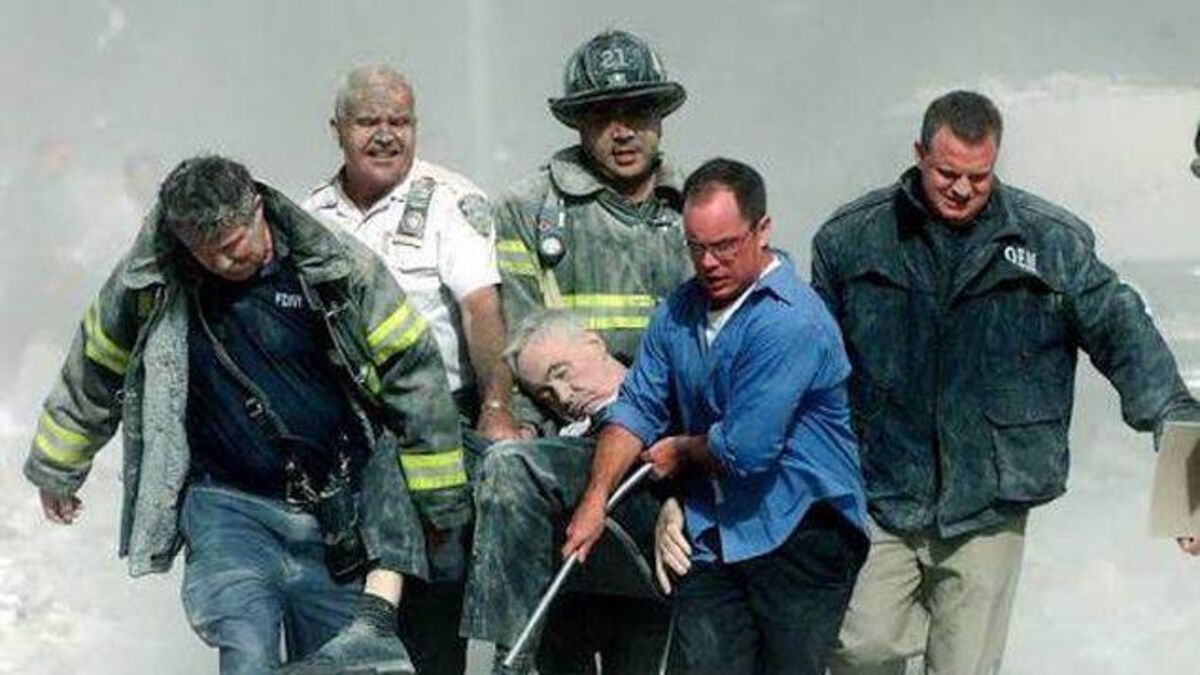
The lifeless body of Fr Mychal (Michael) Lyng, being carried from the lobby of the north tower at the Twin Towers following the 1911 attack
THIS month, September, marks the 25th anniversary of the brutal terrorist attack on the twin tower buildings in New York that changed lives forever. While time has moved on quickly, the loss and devastation as a consequence to he disaster remains present in the memories of billions. The first to be registered dead was an Irish priest, whose life story is deeply inspirational.
Fr Mychal (Michael) Judge, OFM (1933-2001), a Franciscan friar and chaplain to the New York City Fire Department, offers a powerful Christian witness of selfless love, presence with the suffering, joyful gratitude and trust in God. He was the first officially recorded fatality of the 11 September 2001 attacks (victim 0001). He died in the lobby of the North Tower while ministering amid the chaos â praying and being with firefighters and victims âafter debris from the South Tower’s collapse struck him.
Born Robert Emmett Judge in Brooklyn to Irish immigrant parents, he experienced early hardship when his father died when he was six. He helped support the family by shining shoes near St Francis of Assisi church and entered the Franciscans as a teenager, taking the name Mychal (or Michael Fallon Judge). He was ordained in 1961 and lived simply in the brown habit and sandals of his order. He served in parishes, later at St Francis of Assisi in Manhattan, and became a full-time FDNY chaplain in the early 1990s. He was known for rushing to fires, rescues, hospitals and disasters (including the TWA Flight 800 crash), counselling firefighters and families and working long hours. He also ministered tirelessly to people with AIDS during the crisis (helping establish early Catholic outreach when stigma was intense), the homeless and those struggling with addiction. As a recovering alcoholic himself (sober for decades through Alcoholics Anonymous), he brought hard-won empathy and humility to that work.
Friends described him as gregarious, irreverent in humour yet deeply pious at the Eucharist, a bridge builder who moved easily among firefighters, the poor, political leaders and diverse communities. He saw God and goodness in everyone, following the example of St Francis. His life reflected the Gospel call to love the least and the suffering Christ present in them. On 9/11 he ran towards danger with the firefighters he loved, not as a superhero but as someone formed by years of prayer, community and ministry. He prayed aloud in the lobby (“Jesus, please end this right now. God, please end this.”). This mirrors Jesus’ words: “Greater love has no one than this: to lay down one’s life for one’s friends” (John 15:13) and the Good Shepherd who stays with the flock. His body was carried out in an iconic image often called an ‘American Pietà,’ a visual of sacrificial love amid horror.
Despite personal struggles, he was often called the happiest man. He repeatedly expressed wonder at God’s blessings: “Why am I so blessed? I don’t deserve it” and trusted divine care even when he had feared God earlier in life. His recovery and Franciscan formation taught him to value relationship and service over self or prestige.
A prayer he composed and lived by captures his spirituality: “Lord, take me where You want me to go. Let me meet who You want me to meet. Tell me what You want me to say and keep me out of Your way.” This echoes Marian and Franciscan surrender and the Lord’s Prayer. On 10 September 2001, in what became his last homily to firefighters, he reminded them that God is near in danger and that they do what God calls them to, whatever the size of the call.
Caring for AIDS patients (when many kept distance), the homeless and addicts embodied Jesus’ identification with the outcast. His life shows that holiness grows through ordinary fidelity, personal brokenness offered to God and concrete acts of mercy rather than status.
Father Mychal’s story inspires Christians to run towards need rather than away, to find Christ in the suffering and the ordinary, to hold joy and gratitude amid hardship and to pray for the grace to be available to God’s purposes. His final act was consistent with a lifetime of showing up â praying, blessing, listening, and loving â as a pastor with his people. Many remember him as a model of Christ-like self-giving; some have even advocated for recognition of his sanctity. His witness continues to point to the truth that love and faith can shine in the darkest moments.
This simple but powerful prayer written by Fr Judge offers us all an opportunity to indulge in God’s grace and mercy: