Laois woman is ‘champion’ for cardiovascular care
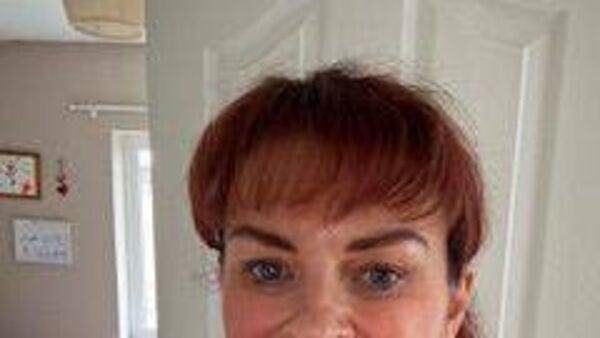
Olivia McLoughlin Sweeney
OLIVIA McLoughlin Sweeney is nursing a dog on her lap, a ten-year-old cockapoodle with light, golden-brown fur named Marlow.
“She’s one of those dogs that wants to be all over you no matter where you are,” the trainee psychotherapist tells me.
It is a bleak morning in mid-December when we meet on Zoom. With grey skies hanging overhead, Olivia discusses undergoing surgery earlier this year for a rare congenital heart defect.
“I was basically made the wrong way, so things aren't in the right place in my heart. I was all mixed up.” Medical practitioners told Olivia that her heart composition was “like a jigsaw.” This carried the very serious risk of Sudden Death Syndrome with any form of exertion.
One medical professional told her about a woman who had what she had. “She only lifted her hands to reach her washing line – only lifted her hands and she was on the ground.
“I was very lucky to get to 49 and not have anything like that happen.” Originally from Dublin but based in Ballaghmore, Co Laois for the last two years, Olivia did not experience any of the symptoms typically associated with having an underlying heart condition for most of her life.
“They were very surprised that I had no chest pain or anything. I never did,” she says.
However, in the last few years, she began to experience an intense swelling on her left side, high blood pressure – which she had never had before outside of pregnancy – and, since 2017, extreme fatigue.
“I was hitting the floor all the time. I was out of breath, having to … stop, sit down.” Olivia had been in and out of cardiac support services multiple times due to a pre-existing hormone condition detected in 2005, but her congenital heart defect was never picked up on.
“I've had loads of scans on my heart. Loads of echoes, all these things.” After her father was diagnosed with heart failure, Olivia was encouraged to further investigate her own health. Going down the private healthcare route, she underwent more testing.
She was informed that all looked okay â the echo, scan and ECG showed nothing out of the ordinary. However, she had failed the stress test.
“I failed the stress test because my breathing was really bad. I wasn't a smoker, so I was like, ‘why is this still like this’?’’ At this point, her fatigue was intensifying. The consultant suggested one more test: a CT scan.
A CT scan is a non-invasive test in which a contrast dye is injected into a patient’s arm through an IV to highlight the coronary arteries. It is typically used to check for blocked arteries.
When Olivia underwent this examination, she noticed that the clinicians returned halfway through to do another dye test.
“I thought to myself, ‘well okay, it's a blockage or something, the dye is not moving. If that's all it is, I can deal with that’.’’ Olivia thought no more of it and carried on with her training in psychotherapy. That is, until the consultant rang her a few weeks later.
“I was actually seeing clients the day he rang me … I happened to be out on a break and he said: ‘you saved your own life’.’’ The consultant told Olivia that she had a rare congenital defect; one she had had since birth.
Olivia returned for another angiogram in July. She was told that she needed surgery and she needed it fast – and so, the very next day, she found herself in the operating theatre.
This was a quick turnaround. “I was lucky enough to be in the private system,” she says.
Her condition was found to be a lot worse than initially realised. “The main coronary artery was compressing one of my valves and it was causing the valve to leak. They were concerned this was going to cause further problems.” Olivia jokes that she could never do anything straightforward. “I would have to be complicated.” Medical professionals reckon Olivia could have inherited her condition from her family. Indeed, inherited heart conditions can be passed down through family lines and can affect people at any age.
“My grandmother would have died at 66 with angina … It’s possible that she could have had this. My dad has heart failure, but they haven't picked it up with him. He had a cardiac MRI the day after I had my surgery and he's fine, he hasn’t got it.
“I was born in 1975, so I suppose they didn't check things. There was no reason back then to do things like that.” Although she is somewhat soothed by the knowledge her condition is very rare, Olivia still wants to get her five children checked, just to be on the safe side. “I have one at the moment wanting to go into boxing. He's the youngest, he's nearly 14.” If he were to inherit Olivia’s condition and experience symptoms, he would need to be transported to Portlaoise, she says.
“Then, they’re going to send him to Dublin,” she continues.
Olivia is concerned that by the time a journey like that is complete, it might be too late for any prospective patient. This is part of what she sees as a major disparity between rural and urban healthcare.
“These are things I've learned and have had to look into because of this condition.” Olivia’s newfound knowledge has inspired her to become an advocate for women’s heart health.
Throughout her healthcare journey, Olivia received support from the Irish Heart Foundation, the national charity for stroke and heart disease prevention and care.
“Medics are great,” she says, “but they didn't have the time to be answering my questions.” Olivia sent the foundation her diagnosis, who then rang her every few days to offer support. Eventually, Olivia was put in touch with one of the foundation’s Patient Champions.
Launched in March 2023, the Patient Champions programme was developed to train and support heart and stroke patients across Ireland on effective ways to advocate change and to support one another.
In a statement, Pauline O’Shea, advocacy campaign manager with the Irish Heart Foundation, said: “Patients no longer want their involvement in advocacy to be represented by occasions of being ‘wheeled out’ to speak and then being expected to leave the room while everyone else makes the decisions.
“They want to feel empowered, appreciated, supported and treated as equals in the room and in partnership with patient organisations and healthcare decision makers.” Olivia’s Patient Champion acted as a guide. “I was his first one and he had only graduated just before us.” He was from a town in Mayo, like Olivia’s father. They later found out he knew her father's family.
“He had had open heart surgery a few times and a stroke, so it was great for me because he was able to help me relax more than the nurses or anyone else because he was able to give me the dos and the don’ts. I wouldn't have gotten through without them.” Olivia later graduated as a Patient Champion herself. Although she is currently finalising her thesis, she wishes to volunteer her time to the Irish Heart Foundation, representing them while lobbying the government to support advances in cardiovascular healthcare.
Pauline O’Shea said that people like Olivia are the unsung heroes of the organisation.
“They are a terrific addition, their lived experience and desire to help others and the organisation speak out about significant issues that affect heart and stroke patients is a powerful combination for working for positive change for patients.”