Long-lost Laois bell unearthed near graveyard
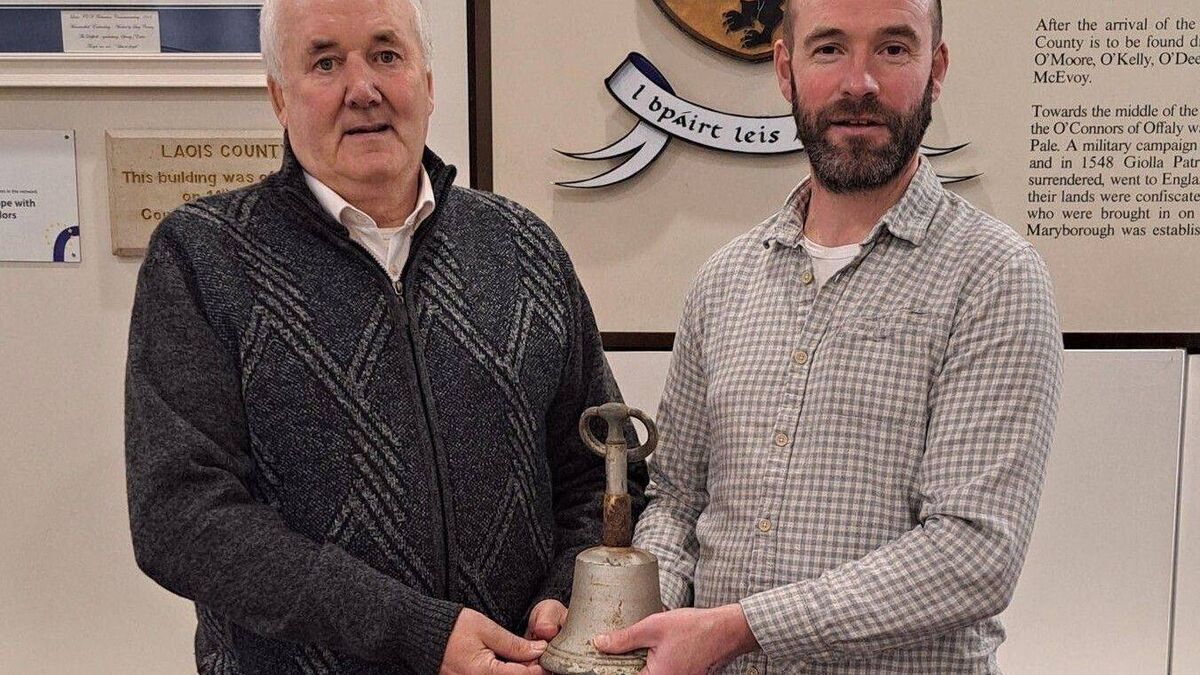
Laois Heritage Officer Thomas Carolan (right) and local historian Noel Burke with the Clonkeen Bell. Photo: James G. Carroll
A LONG-LOST bell that once summoned workers to Mass across the fields has been unearthed near a ruined Laois church and graveyard.
The 18th century Clonkeen bell was presented to delighted local historian Noel Burke, a member of the committee that oversees ongoing conservation at Clonkeen church and graveyard near Abbeyleix.
It is believed that the old handbell, now weathered and worn, may once have tolled across Kenny’s sandpit in Clonkeen, summoning worshippers to the ‘Mass Field’ during the harsh years of the Penal Laws.
The historic bell was handed over to Noel and the parish by local man Darran Hutchinson, whose family secretly minded the bell at their home in Killamuck for more than 40 years.
It is the second important artefact presented to the newly formed Abbeyleix & District Historical Society within just two months, following the remarkable recovery and restoration of the Brigidine Convent Cross in January.
Darran recalled that, when he was about ten years old in the early 1980s, he spent his summer holidays in his neighbour Pat’s workshop, where engines of every kind were taken apart and put back together again.
One day, Pat produced a small handbell and told Darran that he had found it underground in Clonkeen in 1960, just outside the walls of the graveyard. At the time, there was little interest in local heritage but Pat felt that the bell belonged to history and it should be preserved.
Having stored it in his workshop for many years, Pat gave the bell to Darran for safe-keeping when his health failed. Darran brought the bell home to his father’s garage in Killamuck, where it remained hidden and unspoken of within the Hutchinson family for another four decades.
Recounting the story on social media on 7 February, Noel said: ‘Darran wasn’t even born when his neighbour Pat first unearthed the Clonkeen bell. At the time he was given the bell, it didn’t seem to him like a big deal, but he still thought in the back of his mind that the bell might be significant one day.
‘As interest in local history has grown here in Abbeyleix over recent years, the medieval church of Clonkeen has become more important than ever. Darran felt it was right that the bell should now be brought forward and considered properly, especially if it is what we now believe it may be.’
Noel added: ‘I’m deeply grateful to Darran for preserving it and for sharing this memory. Every small act of care like this helps us rebuild the larger story of Clonkeen church and graveyard, piece by piece.
'We have used AI technology, as well as known history of the area, to try to date and tell the story of this bell. I’m sure that, with further research, in time the Clonkeen bell may still have further information to reveal.’
While a monastic site was founded at Clonkeen in the sixth or seventh century, the present-day stone church ruins date primarily to the mid-12th century.
It is thought that the handbell dates from the early 1700s and was used to summon worshippers from Kenny’s sandpit to the Mass Field during penal times.
Noel said that local historian Kevin O’Brien told him stories from the area that were passed down for generations: tales of hidden liturgies, a school near the sandpit and the enduring faith of a scattered community.
Historical records echo these memories. In 1731, the Protestant Bishop of Leighlin and Ferns reported ‘one Mass house in Clonkeen, a boarded covering in the fields at Clonkeen, one priest Fr William Keating PP and one schoolmaster’.
Based on his own research, Noel said: ‘Earlier, Fr Connell Moore had registered as parish priest under the 1704 Registration of Popish Clergy. Tradition even holds that a conference of seven Catholic bishops took place in Clonkeen, a testament to its role as a refuge amid bog and woodland.’
In an evocative account, Noel said: ‘The bell itself bears no inscription. Its form is plain, its clapper hand-forged. But its silence speaks volumes. Whether used in worship, schooling or community gathering, it may be one of the few surviving artefacts from Clonkeen’s clandestine Catholic life, a life that persisted until Abbeyleix became a parish in 1824.
‘Today, as Abbeyleix a relatively new town celebrates 200 years as a parish, this humble bell reminds us of the generations who kept faith alive in fields and forests, long before our churches rose in stone.
‘In 1815, over a period of months, the southern end of what is now the Killamuck bog slipped down from the hill to the west and slowly enveloped many of the mud and stone houses of the northern part of Clonkeen.
‘It is intended that part of this southern end of the bog should now be preserved, both as an example of bog land flora and fauna and because of what future scientific investigation might one day discover underneath the surface.’
Laois Heritage Officer Thomas Carolan will attend the next meeting of Abbeyleix & District Historical Society, which will be held in the town’s Heritage House at 7pm on Wednesday 25 February. New members are always welcome.