Solar eclipse: Concerns over 'knock-off' safety glasses
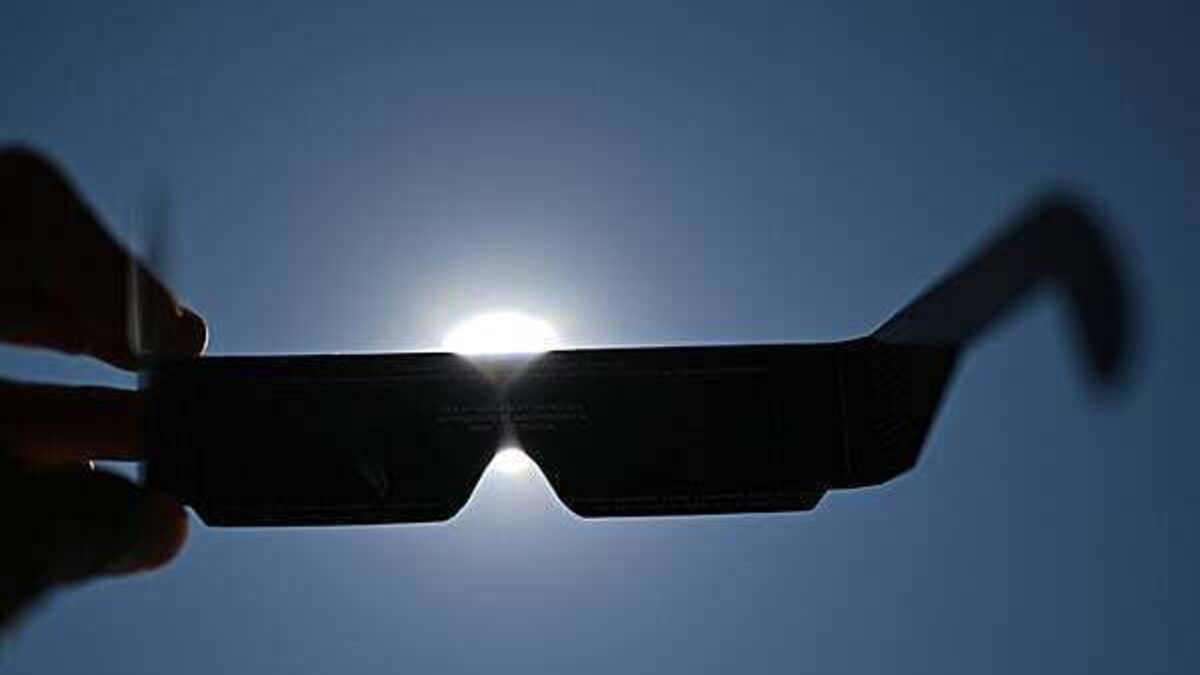
Concerns are being raised around people buying 'knock-off' safety glasses to watch this week's solar eclipse.
On Wednesday, at approximately 6pm, the moon will block the sun for around two hours.
Experts are warning people not to look directly at the sun without the appropriate protection, as it can cause lasting eye damage.
Safety officials remind observers to use ISO 12312-2 certified eclipse glasses during all partial phases of the eclipse. Regular sunglasses, cameras without proper solar filters, X-ray film, and other non-certified protection are unsafe.
Viewing events have been planned to take place across the island of Ireland ahead of what is expected to be the “deepest eclipse” over local skies until 2090.
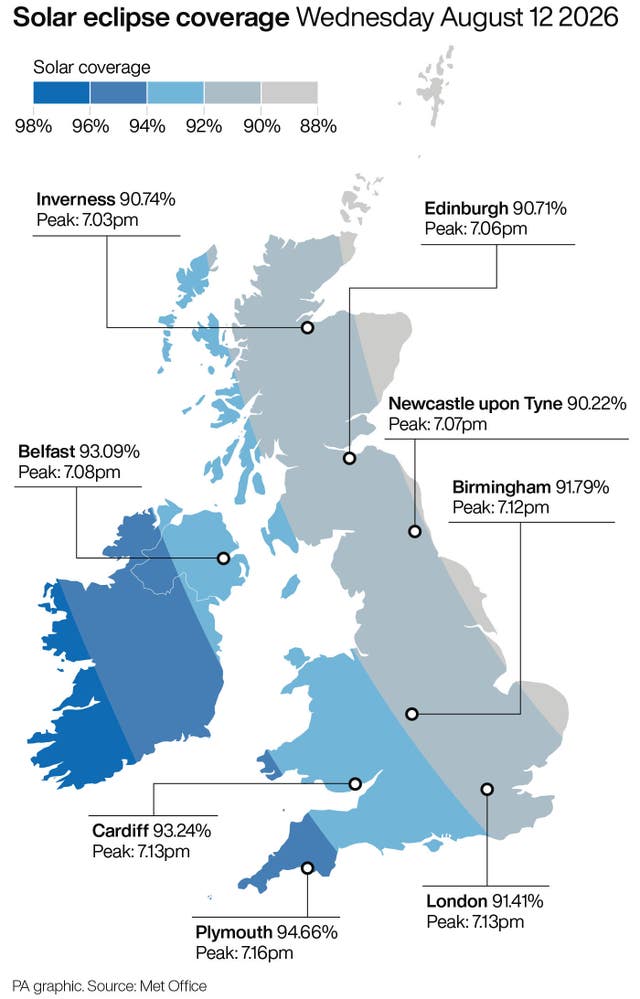
The west and south of Ireland are to see 98% coverage of the Sun, while this is expected to be around 94% in the east and north of the island.
Some areas of the world are expected to see a total eclipse, including parts of Spain, Greenland and Iceland.
Observatories at Armagh, Dunsink, in Dublin, and Blackrock Castle in Cork have organised viewing events, and public events have been planned at Maynooth University in Co Kildare, Queen’s University Belfast and at the Phoenix Park in Dublin.
Director of Armagh Observatory and Planetarium, Professor Michael Burton, described one of the most eagerly awaited eclipses for decades.
“While we won’t encounter totality here – only a narrow path across Greenland, Iceland and northern Spain will be fortunate enough to encounter this – a 94% partial eclipse is an extraordinary sight in its own right,” he said.
“At its peak, the Sun will be reduced to the thinnest sliver of light, low over the western horizon. It is going to be a beautiful and quite eerie spectacle.”
He said the eclipse will begin at approximately 6.10pm, reaching its maximum at around 7.08pm and concluding shortly after 8pm.
Observers can expect to see a striking scene, with the crescent Sun glowing low in the evening sky.
Prof Burton added: “The last time skies over Ireland darkened to this extent was in 1999. On that occasion people travelled from all over to stand under the path of totality in Cornwall.
“You don’t need to travel anywhere this time – history is coming to us.”
He reminded viewers to never look directly at the Sun during the partial eclipse.
“The Sun is never safe to look at directly with the naked eye, binoculars or a camera, no matter how much of it is covered by the Moon,” he said.
“Sunlight contains strong and harmful ultraviolet (UV) light which will damage your eyes. Use eclipse glasses, solar filters or make a pinhole projector using a cardboard box, tin foil and white paper.”
Armagh Observatory and Planetarium is hosting a day of activities from 10am to 8pm, including hands-on science demonstrations, dome shows and eclipse-themed events for all ages.
It will also provide solar viewing opportunities and answer questions about the eclipse and the wider universe.
Space expert Dr Niamh Shaw says the eclipse will be amazing but is advising people to view it safely.
"The creepiest thing is that it gets quite cold within seconds when it reaches that maximum coverage," she told Newstalk. "It will get dark, like it's going to pour rain, it gets cold, and birds - if they are tweeting - will stop. The last time it happened was August 11th, 1999."
The path of totality will travel from Greenland across Iceland and northern Europe before reaching Spain, where millions of visitors and residents are expected to watch the rare celestial event during the peak summer travel season.

According to Nasa, totality will occur at midday in a remote region of northern Russia, while observers in Greenland and Iceland will see the eclipse in the late afternoon or early evening. In Spain, the Moon will completely cover the Sun shortly before sunset, creating dramatic views with the eclipsed Sun low on the western horizon.
For most locations along the path, totality will last less than two minutes, although the exact duration will depend on the observer’s location.
The eclipse will be especially significant for Spain: the last total solar eclipse visible from the Iberian Peninsula occurred in 1912.
The US and Canada will not experience totality from this eclipse and will see only a partial solar eclipse in limited areas.