Walking tour of Old Fort Quarter during Laois Heritage Week
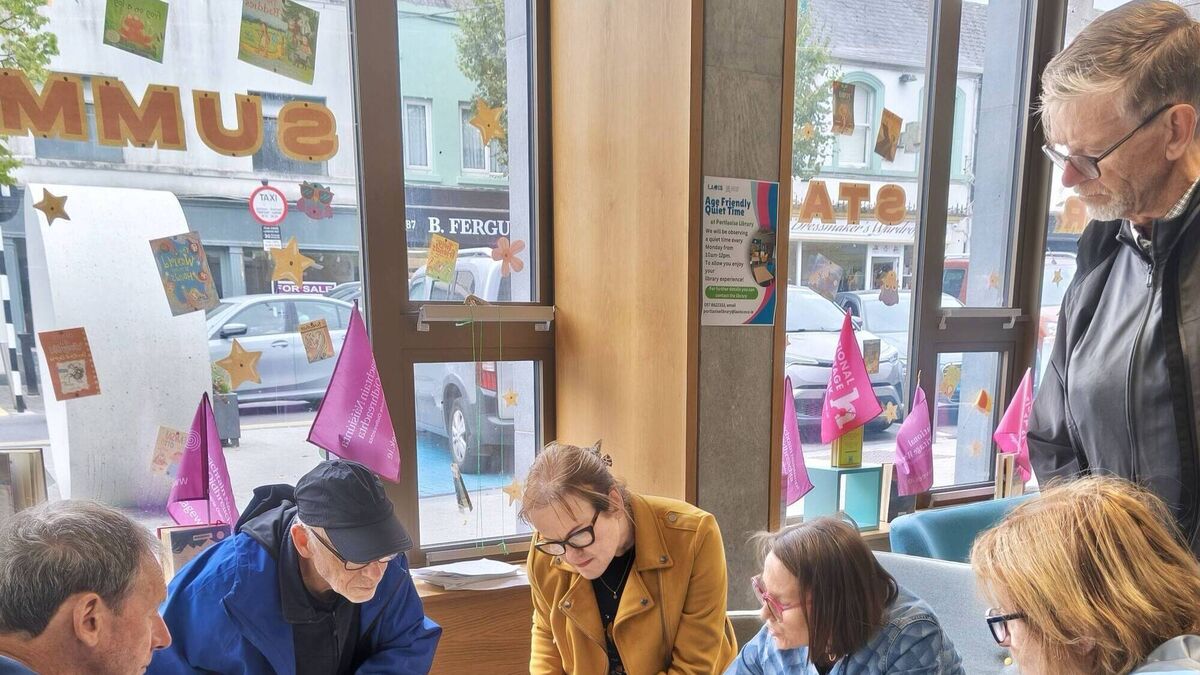
Back at Portlaoise Library after the event Sinead shows some of the group a copy of a map of the origional town dating back to c1560s-1570s Photos: Stan Henderson
THE origins of Portlaoise were revived during heritage week when local studies librarian Sinead Holland led an informative historical walking tour of the Old Fort Quarter.
Starting and ending at Portlaoise library, Sinead kept the attention of history buffs on the tour and began by recounting the key fact that Fort Protector, later Maryborough, gave birth to the modern town, which was built when English authority in Ireland was largely confined to the Pale, the fortified area around Dublin, Meath, Louth and Kildare, where English laws and customs held sway.
Although the Anglo-Norman invasion began in 1169, English control had faded by the mid-1300s after the Black Death, the Bruce invasion and famine. Gaelic Ireland revived and around 1340 Laoiseach O’Moore regained the area from the Norman Roger Mortimer. By the 1540s, Laois was again dominated by the O’Moores.
In 1547, crown forces, under William Brabazon, invaded Laois and Offaly. The 30-day campaign ended with the O’Moore and O’Connor chiefs driven out. Sir Edward Bellingham then sent troops and supplies to secure the territory, with 400 men garrisoned at Portlaoise over winter.
On Church Avenue, attention turned to the Storehouse, a large two-storey building with a stone tower. Over time, it served as garrison, brewing house, gaol, infirmary, priest’s house and convent.
The Presentation Sisters arrived from Carlow in 1824 at the invitation of Fr Nicholas O’Connor, who lived in the old infirmary. Their convent grew from the Storehouse and nearby houses, expanding in the 1880s when the Storehouse tower was absorbed into the new building. Education soon became central to their work. A school in the basement of the 1822 church had more than 200 children and only three teachers.
At Fitzmaurice Place, the focus returned to the fort. Built in 1548 and named Fort Protector after lord protector Edward Seymour, it appeared in contemporary documents as ‘campa.’ The fort measured about 101 by 125 metres. Its most complete surviving wall is on the east side at Fitzmaurice Place, while major sections remain on Tower Hill, Railway Street and behind Main Street properties.
On Tower Hill, formerly Barracks Street, the tour highlighted intact wall sections and traces of early houses found near the fort’s north wall during pavement works. The area also carries an education legacy. The Christian Brothers came to Portlaoise in 1847 and the school building there includes their first school from the 1840s and a 1907 extension.
Railway Street opened another chapter. The railway reached Portlaoise in 1846, with a station designed by Sancton Woodon. Opposite stands the Methodist church, built in the 1880s to replace an earlier Church Street chapel from 1798.
Nearby are the ruins of Old St Peter’s church and graveyard, the first church built in Maryborough. Its date is uncertain, but a church was a condition of the plantation. It was later replaced by the present St Peter’s church in the square, built around 1803 or 1804. Interred in the graveyard is Jeremiah Grant, the highwayman and last person publicly hanged in the town in 1816, though that burial is disputed.
On upper Church Street, Sinead linked the fort quarter to Portlaoise’s civic history. The Old Gaol, built in 1789 to a design by Richard Harman, was soon replaced by the New Gaol on Dublin Road in 1830. It later became an RIC barracks and, from the 1920s, the county library. Today it is the Dunamaise Arts Centre and Theatre.
The walk also recalled Maryborough’s wider growth. The earliest map, from about the 1560s, shows 17 structures outside the fort walls â 15 houses, a mill and the Storehouse. The names beside the houses are mostly English and Welsh.
The 1570s brought renewed gaelic resistance under Rory Óg O’Moore. More than 150 O’Moores were killed at Mullaghmast in 1577 and Rory Óg was killed the following year. The town was burned at the end of the 1500s by Owney McRory O’Moore and only in 1607 were Queen’s County and King’s County finally pacified, with surviving O’Moores and other septs transplanted to Kerry.
For those who wish to learn more, search Laois Local Studies, call into Portlaoise library or phone 057 8622333.