Who is Steve Bannon? Former White House strategist who promised 'Irish Trump'
James Cox
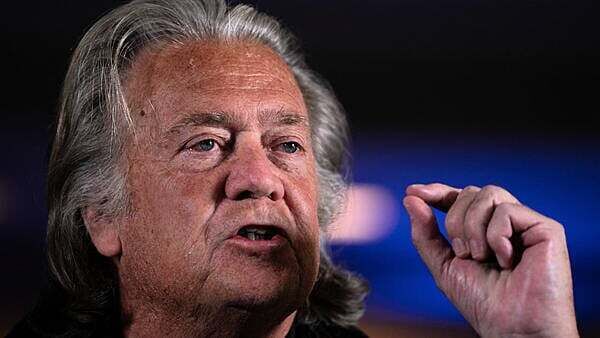
Former White House strategist Steve Bannon has promised an "Irish Trump", adding that he is working to "help form an Irish national party".
So who is Steve Bannon?
Career
Mr Bannon was an officer in the United States Navy between 1977 and 1983. He then spent two years working at Goldman Sachs as an investment banker.
Mr Bannon then entered the film industry, working as an executive producer in Hollywood from 1991 to 2016.
In 2007, he co-founded right-wing US news website Breitbart News. Around 2010, Mr Bannon also became vice president of Cambridge Analytica.
The little-known firm collected the personal details of millions of Facebook users without their consent, and became the focus of multiple inquiries after its role in the 'vote leave' Brexit campaign was revealed.
It also spread misinformation and the firm was also used by the Trump campaign in 2016.
In 2016, Mr Bannon became the chief executive officer of Mr Trump's 2016 presidential campaign. This is where he became a household name in the US and worldwide.
Mr Trump was trailing Democratic candidate Hillary Clinton in major polls at the time, and Mr Bannon was credited with turning the campaign around.
He was a leading voice in the establishment of the Make America Great Again (MAGA) movement, and pushed Mr Trump towards isolationist 'America First' policies.
Mr Bannon was appointed White House chief strategist after Mr Trump's 2016 victory. At the time, he was Mr Trump's most trusted adviser but cracks soon began to form in their relationship.
Mr Bannon was frustrated with Mr Trump moving away from the 'America First' principles he campaigned on, and he fell out with Mr Trump's daughter Ivanka, and son-in-law Jared Kushner, who were serving as informal White House advisers.

He rejoined Breitbart, but left the news website again after his criticism of Mr Trump was reported in Michael Wolff's book Fire and Fury.
Mr Bannon subsequently pledged to become "the infrastructure, globally, for the global populist movement", as he travelled Europe promoting the causes of far-right parties.
He advised Jeffrey Epstein, the financer and convicted child sex offender, on media relations just prior to his arrest on sex trafficking charges and death in prison in 2019.
Outside of the White House bubble, Mr Bannon mended his relationship with Mr Trump and continued to be a leading voice in the MAGA movement.
In 2020, he was arrested on federal charges of conspiracy to commit mail fraud and money laundering connected to the We Build the Wall fundraising campaign.
The lawsuit claimed Mr Bannon and associates had raised funds pledged for Mr Trump's US-Mexico border wall, which was never completed, and used the money to enrich themselves.
Mr Bannon pleaded not guilty and was eventually pardoned by Mr Trump before he left office.
Mr Bannon refused to comply with a subpoena from the January 6th US House select committee, so was indicted by a federal grand jury on criminal charges of contempt of Congress.
In July 2022, he was convicted and sentenced to four months in prison and a $6,500 fine. He was imprisoned from July to October 2024.
He now hosts the War Room podcast, which is popular among far-right groups but considered too extreme among some Republican Party figures.
Why is he interested in Ireland?
Mr Bannon has attempted to further far-right movements across Europe, with limited success.
While Ireland has had little far-right success electorally, Mr Bannon appears to be attempting to inflame anti-immigrant sentiment among far-right groups and influencers here.
In an interview with Politico, he said: "I’m spending a ton of time behind the scenes on the Irish situation to help form an Irish national party."
He wouldn't be the first prominent far-right figure in the US to take an interest in Ireland. Former Fox News hosts Tucker Carlson and billionaire Elon Musk have spread misinformation about immigration in Ireland on a number of occasions.
In the interview, Mr Bannon added: "They’re going to have an Irish MAGA, and we’re going to have an Irish Trump. That’s all going to come together, no doubt. That country is right on the edge thanks to mass migration."
He also expressed support for far-right German party Alternative for Germany (AfD) and Nigel Farage's Reform UK.
“MAGA thinks the European governments, by and large, are deadbeats. They love AfD. They love what National Rally is doing. They love Nigel Farage."
Will it have any impact?
Mr Bannon's comments may well embolden far-right influencers here.
However, his claims of an "Irish Trump" are far-fetched given far-right parties and candidates' lack of success in multiple general elections.
This could change of course, and the Government is believed to be concerned about the rising influence of far-right groups.
Far-right groups in Ireland are small and disparate, with infighting being a key issue when they attempt to amalgamate, so Mr Bannon's promise of an 'Irish national party' also seems unlikely.
However, far-right violence here has come to the attention of international groups.
In a report from the Global Project Against Hate and Extremism (Gpahe), seen by BreakingNews.ie, the authors wrote: "The violence against migrants has made Ireland of particular interest to the international far right, who view the unrest and protests as an inspiration or an example of the white rage festering below the surface as they are forced to endure the indignity of living with unwanted migrants. Images from the 2025 unrest, like masked participants charging police lines on horseback, have been spread across far-right Telegram channels in the US, Canada, UK, Australia, and across Europe."

The report warns that although Ireland's far-right "may be small in both size and power compared to many of its European contemporaries" it "nonetheless occupies a significant position as a place of motivation and inspiration for far-right actors and broader anti-immigration movement".
The report notes: "Many of Ireland’s far-right groups are influenced by American far-right extremists, as they have imported conspiracy theories about 'cultural Marxism' and the white supremacist 'Great Replacement' conspiracy theory that were popularized in the US. To date, none of these groups have had any real electoral success, but are active in attempts to stir up hatred and fear in communities."
Gpahe also point to an attempt by far-right parties in Ireland to amalgamate in what they called the 'National Alliance'.
"This has come to include a swath of small political parties that banded together in 2024 in what they called the National Alliance. While this was a strong showing of unity from the country’s typically fragmented far-right that managed to bring together political parties with xenophobic and discriminatory platforms like the National Party, Ireland First, The Irish People, and several independent candidates, the coalition failed to produce a significant turnout at polling stations and eventually fell apart.
"Outside of the ballot box, the subject of immigration has been mobilizing for the far right, as a handful of smaller groups that target immigrants and the LGBTQ+ community have emerged. Many of these groups use the long history of the Irish people and the Catholic Church to provide religious and cultural justifications for targeting immigrant communities. Others invoke the specter of Hitler’s National Socialism to justify their hatred."
Gpahe co-founder and president Wendy Via said the fact Ireland has overwhelmingly rejected far-right parties in elections should not be "mistaken for immunity".
Ms Via said: "Ireland has long resisted extremist political activity, but that resilience should not be mistaken for immunity. What we are seeing now is a movement that exploits public anxiety, and moments of crisis, to normalise xenophobia and, in some cases, incite violence against vulnerable communities.”