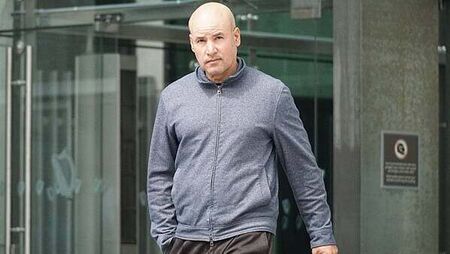
Court refuses to release trial transcripts of notorious sex offender Michael Shine

Declan Brennan
A court has refused to release transcripts of the criminal trials of notorious sex offender Michael Shine to the lawyer heading up a “scoping exercise” into how the case was handled.
Shine, who worked in Our Lady of Lourdes Hospital in Drogheda from 1964 until 1995, was convicted after three criminal trials of sexually assaulting dozens of young boys in the course of his work.
In March 1995, the chief executive of the hospital was informed of a complaint of abuse, and Shine took leave while the complaint was addressed and retired later that year.
Shine (93) of Ballsbridge, Dublin was first charged in 1996 but that case only came to trial in 2003, having been delayed by legal challenges made by Shine’s lawyers.
In 2003, he was acquitted in the first of those trials but was convicted in trials in 2017 and 2019 of assaulting nine complainants and received a number of custodial sentences.
Earlier this year, Minister for Health Jennifer Carroll MacNeill confirmed that the government had approved a time-bound independent scoping exercise in response to long-standing requests made by Dignity4Patients on behalf of victims and survivors connected to Shine.
In March, senior counsel Lorcan Staines began work as the independent facilitator to conduct the scoping exercise within a time frame of 16 weeks.
At a sitting of Dublin Circuit Criminal Court on Monday, Staines made an application to Judge Patricia Ryan for release of transcripts of the proceedings of all three criminal trials relating to 33 injured parties.
Grainne O’Neill, for the Director of Public Prosecutions (DPP), handed in Supreme Court case law which she said outlines that the injured parties in a case must “have their say” with regard to the release of transcripts of a trial.
Judge Ryan told Staines that the court could not go against the Supreme Court precedent. Staines told the court: “Nothing I publish is going in to the public domain.”
In response Judge Ryan said that even so, complainants “should know what’s going on” and said they are “entitled to know where their details are going”.
She told Staines that he could make the application again “if you can tell them those 33 people have been notified”.
Staines said as part of the scoping exercise he has spoken to “many complainants” as well as to a representative organisation representing “hundreds of complainants”.
He said there’s “something in the region of 400” complainants and that it’s not clear which of them have had trials. He said his report is due next Wednesday and that it was “pretty clear” from correspondence last April with the DPP that “there was no issue”.
Judge Ryan put it to O’Neill that the DPP knew the transcripts were being sought. O’Neill replied that at that point “there was no application before the court”. She said the DPP was neither objecting or consenting to the application.
She told the court that the DPP has addresses for the people whose complaints went to trial but that many of them would be out of date, with some going back to 2012.
Staines asked the court to release the indictments of the trials and Judge Ryan allowed this.
“I am giving the indictments out on a limited basis to allow Mr Staines to make inquiries,” she said, noting that the proceedings come under the “in camera” rule.
If you have been affected by any of the issues raised in this article, you can call the national 24-hour Rape Crisis Helpline at 1800-77 8888, access text service and webchat options at drcc.ie/services/helpline/ or visit Rape Crisis Help. In the case of an emergency, always dial 999/112.