A life in focus: Veteran Laois photographer Michael Scully
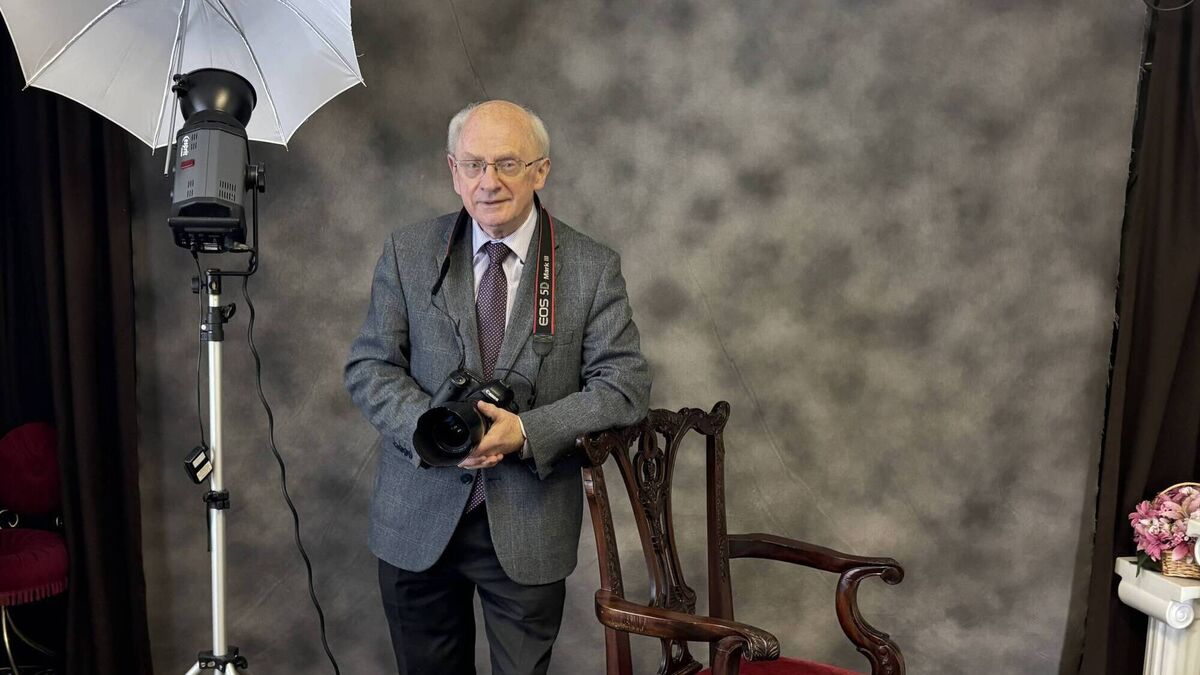
Michael Scully at his studio in Portarlington
MICHAEL Scully was only 13 years old when he picked up a book in Portlaoise library entitled . The Stradbally native had already developed a passing enthusiasm for photography, but now his interest was well and truly piqued.
This was 1959. At that time, film development kits could be purchased in local chemists, and that’s exactly what Michael did. He bought a developing tank, reels, and “the usual bits and pieces” and set up a makeshift studio on his family farm a few miles outside Stradbally.
Seeing as his family no longer kept horses, Michael repurposed the empty stables on the property for his dark room. “Because there were no windows, it was ideal – no daylight”, he says. And so, an illustrious career was born.
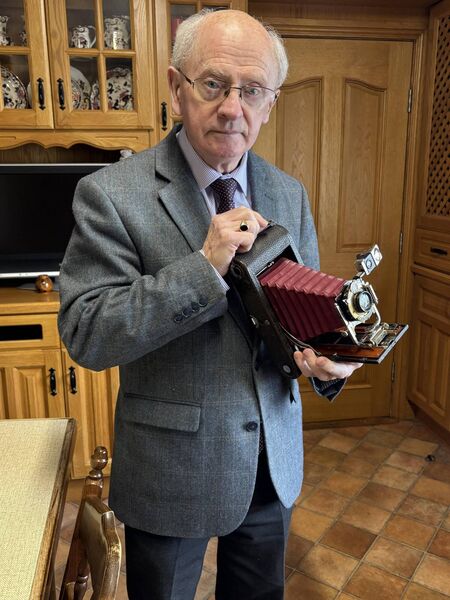
Laois natives will be familiar with Michael’s work. For over fifty years, he has photographed communions, weddings, GAA matches, retirements, birthdays, incidents, accidents and everything in between.
As a news photographer, he has been a regular contributor to the – his work has illustrated and illuminated the paper’s reporting for decades.
But it was a career born of humble beginnings. Michael still recalls one of his earliest subjects: a spider’s web. Taken with his very first camera – a Coronet 66, named for the 6x6cm images it produced onto film – Michael photographed the web when it was coated in dewy droplets.
“When there's a fog, the next day you can see all the spiders' webs”, he recalls. “They're always there, but you don't see them until you have the fog and the dew.”
On 27 December 1965, he photographed the first of what would become an annual event in Stradbally: the Steam Rally, a showcase of vintage steam engines. By 1969, aged just 23, he had developed a network of customers who would ask him to take pictures of various people, events and happenings across the county.
Despite his growing client-base, he was still in full-time employment in another field. That would soon change when Michael stumbled upon a notice in the .
“They had small ads in the back of the paper … I always looked at them to have a look at what equipment was available second hand, because I couldn't afford a brand new”, he says.
Michael encountered an advertisement that read ‘professional photographer in provincial town requires assistant’. He replied with a letter and sent it to a box number. Two days later, Michael’s brother Tom – who lives on the family farm in Stradbally – telephoned Michael to inform him a telegram had arrived for him.
“People only got telegrams if someone had died”, recalls Michael, who asked his brother to open it. The telegram said very little: ‘Please phone Carrick-on-Shannon 84’, it read.
Michael sneaked out of work to a kiosk beside the courthouse in Portlaoise and phoned the number. “It turned out to be John Keaney, a photographer in Carrick-on-Shannon. He had a second studio in Sligo; he was very well known in the west of Ireland.”
John asked Michael to come visit him in Carrick-on-Shannon. The young photographer excitedly agreed. The only issue: he had no transportation.
“My brother drove me up … That was before motorways, it was a good three-and-a-half-hour journey.” John brought Michael in and showed him around. He assured the young photographer that his brother need not wait around. “He said, ‘no, don't worry, I'll bring you back’”, Michael remembers. A kind gesture, given the journey’s length.
John spent the entire day showing Michael the town. In return, Michael showed John several prints – a portfolio of sorts – to showcase his work.
The meeting felt very casual, not at all like a formal job interview. “All along, I wondered when the interview would be. [There was] no sign of an interview.” Michael stayed overnight. The following day, a Sunday, John drove him home.
“We were almost home, we were in Stradbally”, Michael says. “And [there was] no mention. I said, ‘oh, I'll have to ask him.’” He turned to John and asked, “‘Well, what about the job? Do I have it or not?’” John replied, “Oh yeah, when can you begin?”
“You see, all along, I didn't need an interview”, says Michael, reflecting on the moment 57 years later. “He had a full day to size me up and say, ‘what's this fellow like?’ It's very clever way to do it.” Michael handed his notice in in Portlaoise and started working for John in Carrick-on-Shannon. It was a kind of internship into the world of photography. He assisted the veteran photographer with weddings, confirmations, christenings, passport photos, and newspaper work for the and .
In one notable bank holiday weekend, Michael and John had to cover 13 weddings. The strangest event Michael was asked to cover was a funeral. “I felt very uneasy about it, but the person who died had no relations in Sligo. All his family had emigrated to America.” Michael spent a year in Carrick-on-Shannon before he was sent to John’s other studio in Sligo. After another year, he got “itchy feet.” And so, with the support of a local businessman who became guarantor for a loan, Michael returned to Stradbally and set up his own studio on Main Street.
By 1971, he was up and running. Well, just about. He did not have his own phoneline yet and interested patrons would have to call the kiosk across the street to reach him.
“If the phone rang, somebody would eventually answer, ‘can you get Michael Scully for me?’” In 1973, Michael moved to Portarlington and set up shop on Patrick Street, before moving once again to his current premises in 1981. He now operates his studio out of an extension built onto his house.
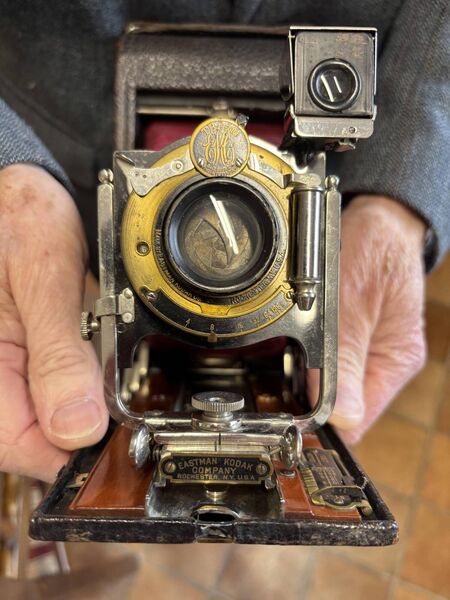
Michael began working with the in 1977, following the death of Terry Redmond, a photographer for the paper.
“They had no photographer in Portlaoise area, so they contacted me, and that's when I began working for the .” Getting a photograph in print was an arduous task compared to today. Michael breaks down a typical weekend: “I used to cover sport as well as other events. On a typical Sunday, I would usually go to Portlaoise, do two matches, come back home, develop my film, hang the film up to dry, have my tea, [go] back into the dark room, print pictures.
“When I would have all the prints done, it could be 11 or 12 o'clock Sunday night ... I would put them all in an envelope, bring them to the railway station … It would be closed, of course, but I had an arrangement: I'd slide in the envelope and that would be put on the first train to Kildare on Monday.” The photographs would then be collected in Kildare, put on the Waterford train, and then taken off in Carlow, says Michael.
“The part I disliked most was writing the captions for each.” The more things change, the more they stay the same.
Michael has seen a lot of changes throughout his career. When he started working with the , the entire paper was printed in black and white. Then colour photography began to appear with increasing regularity throughout the 1980s.
However, the biggest change, he says, was the move to digital. He first began to hear rumblings about digital photography in 1998. “It was way in the distance and I thought, ‘well, no, digital won't affect me’”, he says.
He was wrong, of course. “I had to learn fast. I had to do a computer course, and then eventually I had to purchase a digital camera.” Photographs could now be emailed in an instant. No longer did Michael have to slide them under the door of a railway station.
“I still like a nice black and white print”, says Michael. “But I no longer have my darkroom … I'm very happy about that. It means that I'm not stuck in a dark room with chemicals and all sorts of smells.”
As a press photographer, Michael has met multiple politicians, including former Taoisigh. In fact, Michael says a former Taoiseach became irritable when he tried to reposition him in a photograph (just which Taoiseach it was Michael will not say).
“‘You photographers are always the same, giving orders’”, Michael alleges the former Taoiseach to have said, to which he replied: “Sorry Taoiseach, but I have a job to do.” Did it work out okay? “I got my picture”, he says with a smile, quickly adding: “generally I have to say politicians are good – very receptive, cooperative”.
Michael met his wife Mae in 1969 at a local dance hall. By the 1960s, dances in local halls were a popular social occasion for young people in Ireland, with many using them as an opportunity to cut their teeth on dating for the first time.
“I used to go to Danceland in Portlaoise on a Friday night and Dreamland in Athy on Sunday night. I gave Mae a dance now and again, or maybe every night”, says Michael.
At dances, women would line up on one side of the hall and men on the other. “When a dance was called, the men would walk over and ask the ladies to dance”, he says.
It sounds like a formal affair. “It could be a stampede at times”, says Michael.
After sharing a few dances, Mae reached out to Michael through his cousin John, whom she knew. She wanted to know if Michael would accompany her to a dinner organised by her employer. “I did and that was it”, he says.
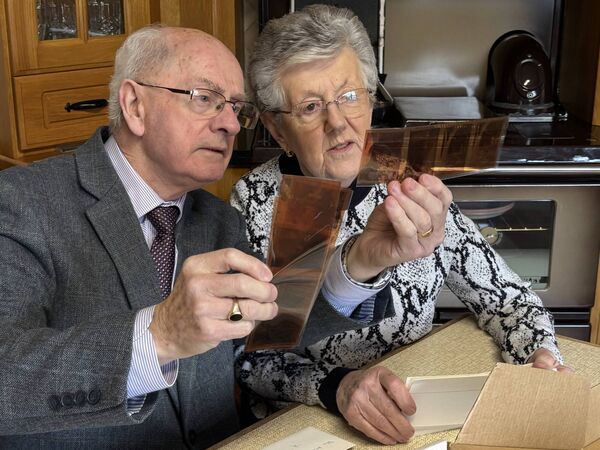
Michael and Mae married in 1973. Mae has been a major help throughout Michael’s career, assisting him with the filing and indexing of his prints.
The pair celebrated their golden wedding anniversary in 2023. “Thank goodness we're still in good nick”, says Michael, who turned 80 in February.
“I said I might retire this year, but don't see any sign of it yet”. Indeed, the day before our meeting, Michael had photographed Cllr. Padraig Fleming’s retirement from Laois County Council and had booked another job for the coming weekend.
Michael is in the early stages of developing a book of his photographs. “I’ll have to see if I can finance it first. If I get the go ahead, I'll be straight into it because I do have, as you can imagine, plenty of material. It’s just a matter of what to select.”