Head of European Commission Peter Power and the Laois connection
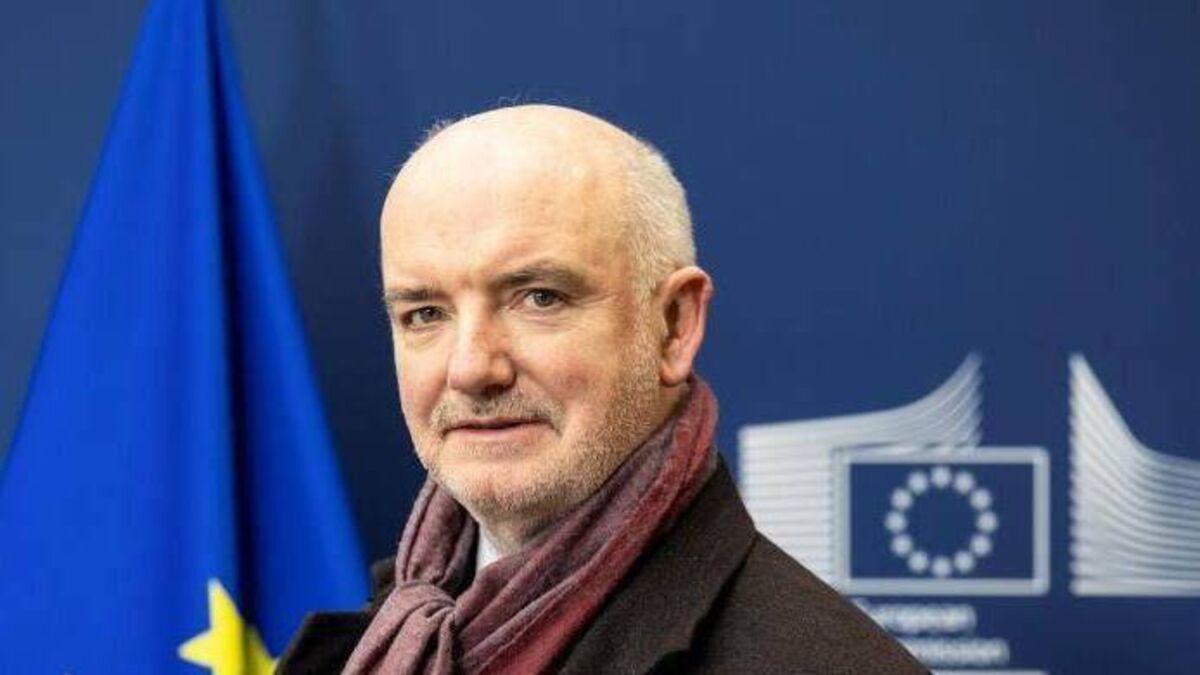
Laois-educated Peter Power
ON 1 July, Ireland will play host to the Council of the Presidency of the European Union, with each county in Ireland slated to be twinned with another EU member state – Laois will be paired with Malta and will, among other events, receive the Ambassador of Malta. And set to play a key role in the upcoming presidency of the council is the Laois-educated Peter Power, head of the European Commission Representation in Ireland – a role which is akin to that of an ambassador for the EU.
Before embarking on a career that would take him across the length and breadth of European policy, Peter attended Cistercian College in Roscrea as a boarder, where he graduated alongside a Laois man who would go onto be heavily involved in the Irish political sphere, Barry Cowen.
His education in the midlands continued at the University of Limerick, where the then head of the EC Representation in Ireland delivered a speech to his class. "Terry Stewart, who was one of my predecessors here, came to Limerick to give a lecture on the Commission and I thought that I wanted that job. And that was 38 years ago."
Following on from his studies, Peter embarked on a stage traineeship in September 1989 and then went on to work for TJ Maher, one of the key figures behind the foundation of the IFA.
The year 1995 saw him join the chapter of the European Commission which negotiates relations with the European Parliament. Following several years working in the cabinet of the then British Commissioner and in various spokesperson capacities in the UK, he moved back to European roles, shuffling through several different departments before finally being appointed, almost exactly a year ago, to the role he currently occupies, which he sought after his student days.
"I've been here a year on Monday. The role is to act as eyes and ears, to feed information back to Brussels, to feed information from Brussels to government and stakeholders and interested parties, to raise the profile of the Commission. To host debates and other similar exercises. To make sure we have good press coverage on Commission discussions and initiatives and so on. Obviously, organising commissioners visits to Ireland …and with the presidency coming through in July, there is already quite a big uptake with commissioners coming through."
Peter is referring to Irelands' forthcoming Presidency of the Council of the European Union, an EU wide body that is one of the bloc’s main decision making institutions; it represents the governments of 27 EU member states and facilitates debates between ministers and heads of state on policy, provides a platform for the amendment and adoption of EU laws and policy co-ordination in key areas, including trade, foreign policy, defence and agreeing the EU’s annual budget with the European Parliament.
Irelands' role throughout this political maelstrom will be to facilitate, manage and preside over all of the above policy related discussions and, faced with this term’s in-tray, many in government may, far from preparing to revel in the pomp and ceremony of hosting European leaders, may be bracing themselves for a bruising six months of fraught and intense debate.
They must contend with – clears throat – Trump and trade, Ukraine, EU expansion, Mercosur, future trade agreements, Trump and Greenland, Iran and countless other issue, but before work can even begin, the Irish government must ensure the security of the presidency itself.
During the presidency, the Republic will play host to the largest gathering of foreign leaders and dignitaries it has ever arranged and there are some in security quarters who have questioned the ability of Ireland – which lacks a major military – to secure these leaders' safety for the duration of the presidency – an especially pertinent issue given the recent sighting of a drone over Irish shores during Ukrainian president Volodymyr Zelenskyy’s visit.
But Peter believes that the Irish government has the issue of security well in hand. "Well, I think the Zelenskyy visit went off very well, despite the story about the drone sighting. The police here are excellent and there is a sizeable budget put aside for policing and for making sure the mechanics of getting people from a to b is fully secured. I think, generally, people have the confidence in the police to do what is required of them."
The overall policy in-tray represents how much the European Union writ has grown in the years since it was just the coal-and-steel mining community and, through its expansion, Europe, as a political bloc has, in Mr Power’s'view, become a more cohesive, unified bloc and politically powerful.
"The nature of the European Union has changed considerably over the years. Back in 1973, it was obviously an economic project, but over the years it has obviously evolved into something that’s much bigger and deeper and political. Under Mrs Von der Leyen in the past few years there have been pretty big changes. They would include the purchasing of arms in the Peace Fund, the buying of vaccines during covid because the Commission doesn't have competence on health, but she saw the absolute need for this and she, herself, has earned the right to be the answer to Mr Kissinger’s question of ‘who do you phone in Europe’ and I'd say it’s quite clearly and uncontestably her."
Peter identifies Ireland as one of the strongest supporters of Europe and the overall European project â that being said, many in Ireland have expressed increased concern with what is perceived as the growing militarisation of the EU, with many questioning if our traditional position of neutrality in global military affairs is at risk. In terms of Ireland’s role here, Peter said: "I think we've moved along in a very measured way. The debate around defence and security should become a debate about security and defence. With security in capital letters. There is a real issue for Ireland in terms of cables that come through the sea. These infrastructures have to be absolutely protected and there we can't always necessarily do it on our own. There is a need for working with our neighbours – our fellow members of the European Union. We are not now or never in my generation joining NATO, but we are going to play a bigger role in European initiatives in this area."
The issue of European security is one which has brought a renewed urgency to the issue of further accessions into the EU; a process has historically creeped forward at a glacial pace now being eyed for a rapid overhaul with North Macedonia, Montenegro, Albania and, most notably in this case, war-torn Ukraine. However, and especially in the case of the later Eastern European country, many in Europe are pushing back against their entry in the next few years, concerned that a rushed accession could open a Pandora’s Box of problems for the EU and the single market.
On this, Peter cited his experience in enlargement and said: "One of the surprising and very positive things I learnt there is that Ukraine’s civil servants, despite the war, were functioning in a way that civil servants function in every other country. They were adapting Ukrainian legislation to become compatible with European legislation and this with bombs going off in the streets right around them, so the capacity of the Ukrainian civil service to deliver is pretty impressive. I think it would be very remiss of us to miss the opportunity to bring Ukraine in. It will cause problems, especially in agriculture, but it will pale into insignificance, I think, compared to the output of Ukraine."
While support for the EU remains broadly high in all quarters across Ireland, the recent Mercosur Trade Deal has dealt a significant blow to support across Irish farming communities. Peter agrees that Mercosur has become synonymous with fiasco in terms of how it was handled in relation to Ireland, but he does also contend that it has been historically misunderstood.
"The Mercosur debate has been a bit of a fiasco, to put it mildly. I think we have failed to understand the deal. We have failed to understand what was in it for farmers, among others. The farming lobby and farmers in general had huge success in terms of forging change to the supporting instruments around the deal, namely the safeguards, the compensation fund if there was market disruption, … all of these were substantial victories for the farm industry and, in a way, they were never acknowledged as such and, unfortunately, those who should have been out campaigning for the Mercosur deal stayed silent and this is the big tragedy of Mercosur."
In a world where the US is increasingly turning its back on many of its traditional allies, where Russia menaces the eastern flank of Europe and Europe looks in danger of being left behind and becoming "a middle of power" as the prime minister of Canada, Mark Carney, said. But Mr Power rejects this supposition: "Well, in a way, Europe should be a great power. When you think of the size of the single market, when you think of the size of the population. And I think we're getting there. I think the direction of travel is clear. I don't think we are a middle power in the sense that Mark Carney was talking about.’’ We discuss the recent Greenland situation, where many perceive that Europe was at last taking a tough line on Trump, which proved effective in securing the bloc’s interests: "With the Greenland situation, the perception was that a muscular approach was taken and that there were positive results. I mean, these are difficult relationships to manage and you can get it wrong as well, but I think Greenland will be sighted by those who favoured strength and unity.
As we wrap up our discussion, Peter expresses his hope for the continuing growth of the development of the European project, but also cautioned that there "has to be greater debate in all countries, including in Ireland, in terms of understanding what Europe is about. Why it makes sense. Why there is no alternative, really. So, I would hope for some serious debates about the future of Europe on a range of different points of view. I think we need to widen the tent and bring people in and that’s why articles in newspapers are a very important part of the debate."