Laois protest fuelled by solidarity
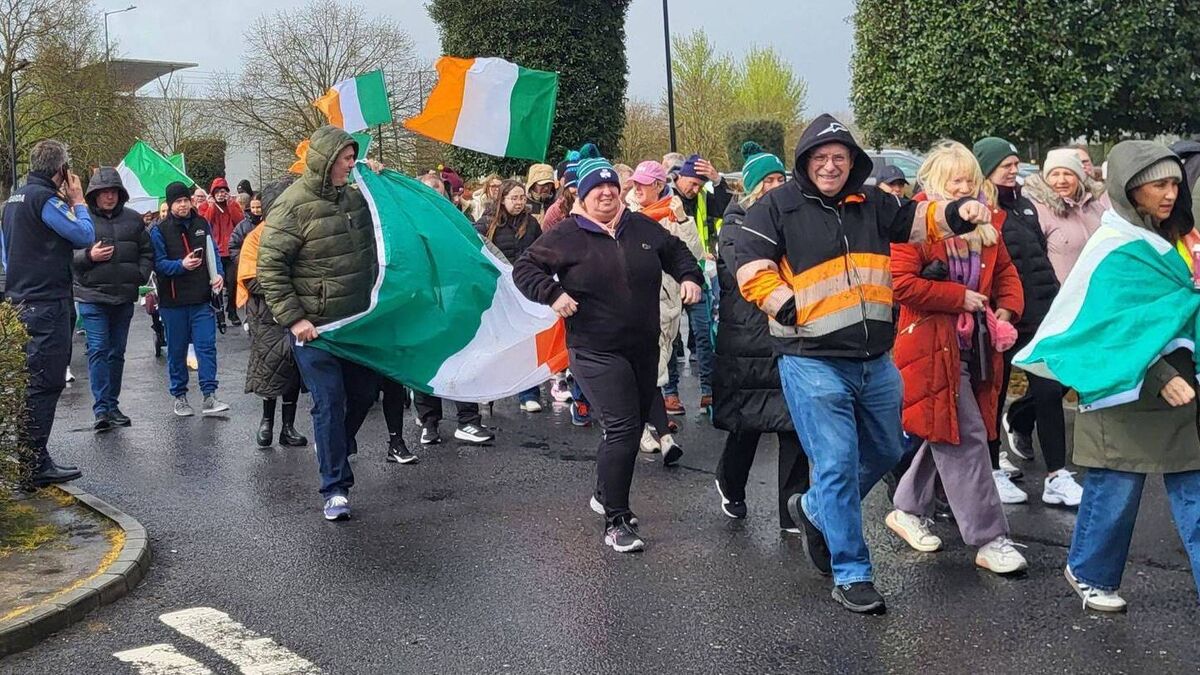
The tricolour was in full flight and sight for the march
A BLOCKADE of junction 17 on the M7 Dublin Road, which saw traffic along the Dublin, Cork, Limerick route disrupted while the entrance to the motorway itself saw traffic grind to a standstill has ended.
Having kick-started on Wednesday last with a convoy of truck, tractors and hauliers setting out from Portlaoise People’s Park to the junction, the protest was sustained overs five days until Sunday, with protestors hunkered down in the driving rain until the government announced additional support measures and protestors departed the site in a staged withdrawal organised by the gardaí. An attendee at the event hailed the ‘strength and solidarity of the proud people of Laois.’ Days after the nationwide protests threatened to decimate petrol stations nationwide, the almost industrial scale strike action has wound down, thanks to a combination of the government cracking down hard on some groups, particularly those shuttering the nation’s oil refinery and key ports, and by announcing additional supports for those most adversely affected by global fuel shortages.
The measures include: the government will reduce excise on diesel by a further ten cent, bringing the total reduction to 32 cent and will also reduce the excise on petrol by a further ten cent, which will bring that total to 27 cent; the planned increase in carbon tax, which was slated for 1 May, will be delayed indefinitely; and to support the haulage and coach sector, the government will establish a new Road Transporters Support Scheme, which will be a near identical support programme to the Licensed Haulage Support Scheme, which was also targeted at alleviating the pressures felt by the Irish transport sector in the immediate wake of the Russian invasion of Ukraine.
During the crisis, major fuel stations in Laois were forced to restrict output, with each customer only granted €50 worth of outflow, barely enough to cover half a tank of fuel. Pumps and signs sprung up at service stations â and in many instances are still in place â adviseing customers of the €50 limit. The Corrib station in Mountmellick was among those that set a €50 limit on fuel purchases per customer, while those who did not set limits warned that they would have run out of fuel by last weekend.
During his visit to the protesters, Independent TD Brian Stanley made clear his view that the only way the issue would be resolved was if the government met them. He said: "The only way this is going to end is when government meet with ye and come up with some reasonable solution to try and meet ye in terms of your demands because I understand your profit margins have completely wiped out and you're operating at a loss at the moment and you can't keep doing that."
Where did it all begin? â with the Portlaoise-based protest advocate James Geoghegan’s call to action that brought over 200 rancorous farmers and hauliers to a hotel in Portlaoise for a pre-protest gathering? With the government’s persistent inaction on skyrocketing fuel prices that have dominated headlines for months? Or with the actions of the most powerful man in the world on the eve of 28 February, launching attacks on a country that would open a Pandora’s box of problems for the world economy? A war and crisis that has spread as swift as an infection across the globe, from the sun-scorched deserts of the Middle East all the way to Ireland. Why?
Protest fuelled by solidarity Continued from page 1 The Strait of Hormuz is what’s given this conflict global fuel; an oil and gas shipping lane vital to the transport of upwards of 20 per cent of the world’s liquified natural gas and a key corner of Iranian territory, Kharg Island, happens to sit at an especially narrow chokepoint in the strait and has become a crucial bargaining chip for the Iranian regime.
Throughout the conflict, only the ships of Iranian allies have been allowed through, which resulted in a global shortage of oil that is striking the world economy hard. Due to the conflict, fuel prices skyrocketed worldwide, air travel, manufacturing and, most crucial for the people of Ireland, the day-to-day cost of petrol and diesel at the pump.
RTÉ reported that diesel prices alone had risen from about €1.70 a litre to €2.17, while petrol had jumped up by an additional 25 per cent per litre; record highs and a number that continues to climb rapidly, this despite the recent announcement of a two-week ceasefire in the US-Iran conflict – at the time of writing next to none vessels are daring to cross the chokepoint and many experts are predicting that even, in the unlikely event, if this marked a full cessation of the conflict, fuel prices aren't likely to fall for some time.
The tremors of the conflict have sparked ire among those farmers, hauliers and business owners across Ireland whose businesses live and die on the price of fuel, motivating a widespread grassroots protest movement, organised through word-of-mouth and a litany of WhatsApp groups that saw tractors and trucks blockade critical infrastructure across the country; in Tipperary, the Northbound M8/N8 at Cashel was closed, while the Castleroy road through Co Limerick was shuttered; the deep water port at Foynes in Co Limerick and the Whitegate Oil Refinery in Cork, Ireland’s only such refinery, were closed; while part of the M50 and Dublin City centre were impassable.
Throughout the protests, the government repeatedly slammed protesters’ actions, likening their expressions of protest to acts of national sabotage. Government ministers highlighted how these actions risked fuel supply for vehicular drivers, the integrity of national water services and how they also threatened the availability of medicines and animal foods.
Yet, despite this, many politicians came out in support of the protesters, including those from governing party Fine Gael â Sean Fleming, John King, Ollie Clooney and Paddy Buggy. Speaking to the Laois Nationalist, Portlaoise councillor and farmer Paddy Buggy said: "I’ve come out in support of the fact that the price of oil is too dear and that we need to get that down and the people who are out protesting are extremely hard-working taxpayers who keep the economy rolling. The price of oil has gone through the roof and, listen, that’s down to what' s going on in the Middle East. However, we have to try and live in this part of the world, too, and people just can't afford it. The people who are paying for everything, that squeezed middle of which I consider myself to be one, is paying for everything and it's just getting to breaking point now at this stage."
Cllr Buggy highlighted his own recent experience as a farmer purchasing agri-diesel, describing how the jump in cost from 98 cents a litre to 172 has made it so that he will barely break even on his agricultural business this year. Fertilisers, the cost of contractors, plastic for silage, construction, tarmac â everything had gone up.
The councillor argued that the government needed to prepare a package of measures to ease the crisis which would have to involve the exchequer taking a hit in terms of its tax intake, but that it was a necessary measure when faced with a national crisis of this scale. He expressed his contempt for what he labelled the small sector of Irish society that are hijacking the protests and making them an anti-government issue.
The councillor continued: "And my heart goes out to people who are going to try to make hospital appointments, people getting chemotherapy and they're held up in traffic jams. No one wants that. And I'm not able to defend that because God love anyone who has to have medical interventions that they need to be able to get to their appointments with less hassle.
‘‘It’s better to lose billions in the exchequer than to have a whole load of people going on social welfare for God knows how long. And that’s what can happen. And that’s why I'm supportive of the fact that the price of oil is too high.’’ The councillor acknowledged that such hits to the exchequer are only short to medium term fixes. However, he anticipated that if the current crisis in the Middle East persists into the medium term that the government could be looking at an entire reshape of the Irish economy, something akin to that of a war economy.
"At the end of the day, we need a roof over our head, we need food on the table and we need to be able to pay for all of that. But we don't need to have fancy sports complexes being built, for example, at this point in time. So, you have to kind of cut your cloth to the measure of what you have coming in. But you keep the economy safe."
Laois Fianna Fáil TD Sean Fleming also threw his weight behind the protesters. In a recent video statement, he urged the government to introduce fresh cost of living measures. He said: "I’m calling on the government to cap fuel prices now. Since prices went up at the pumps, the government is getting more money from taxes. I believe it is important to keep costs down at this stage for the entire economy, as this will help keep inflation down because, if costs go up, people will want wage increases to match the new inflation rates. And it will be much cheaper for the government in the long term and add stability to the economy by keeping costs down, inflation down and I'm asking the government to do that."