Man pleads guilty to 32 counts of dog cruelty on farm
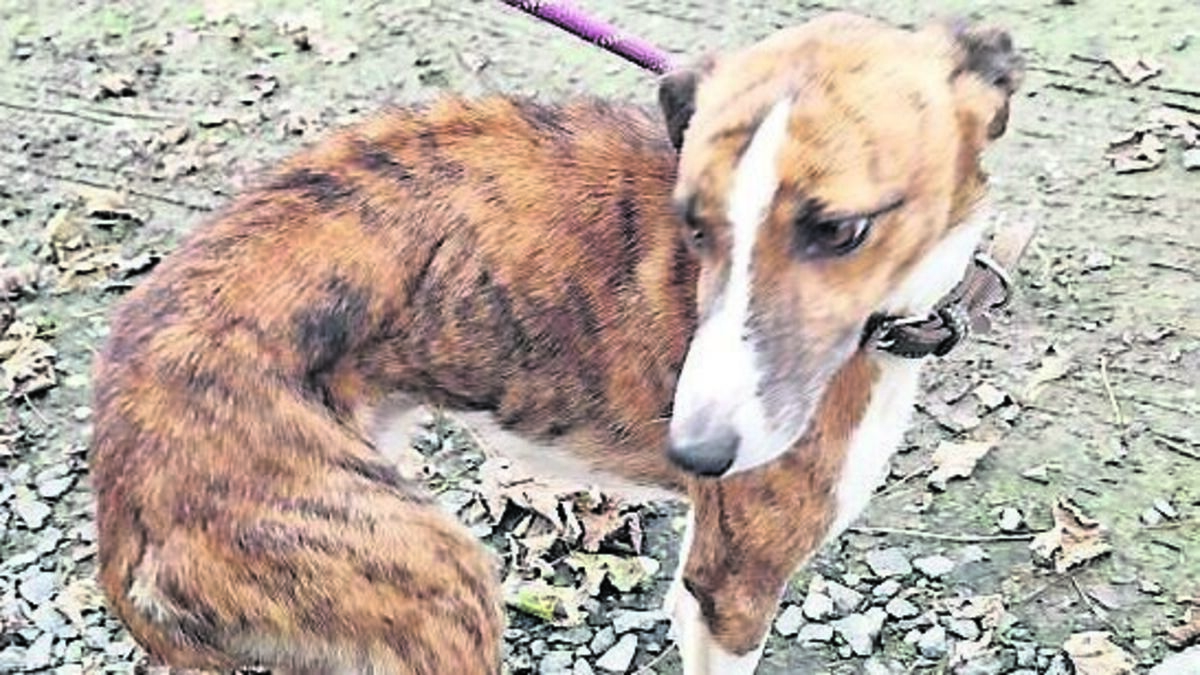
An emaciated Lurcher that was found on the property by the NSPCA officer
A MAN who pleaded guilty to 32 counts of animal cruelty has been warned by a judge that he is in danger of being sentenced to “significant time” in prison. Speaking in Carlow District Court last Thursday, Judge Geraldine Carthy said: “What I have seen is actually shocking, unacceptable and will never be tolerated by this court or any other court.”
The court heard how the National Society for the Prevention of Cruelty to Animals (NSPCA) was contacted in October 2024 over concerns about the welfare of 20 dogs on a farm at Munny Upper, Coolkenno, Shillelagh, Co Wicklow that belonged to 39-year-old Bernard Jackman.
Fiona Conlan was the officer who responded to the call and she carried out the inspection on 31 October 2024. She attended the property, knocked on the front door but found no-one home.
Ms Conlan then came across an outhouse where she found a female Jack Russell which she described as “filthy and underweight” and not microchipped. Microchipping dogs in Ireland became compulsory on 1 June 2015.
The female Jack Russell was with four pups and all of them had had their tails docked. Ms Conlan explained to the court that the vet who had seen the dogs, which were removed from the property, believed that the tail docking had been done to these dogs when they were two weeks’ old and that it had caused severe and unnecessary pain and suffering to them.
Tail docking has been prohibited since 2014, when legislation was passed which ruled that docking could only be done in very specific circumstances, to do with hunting and pest control, and had to be carried out by a veterinary practitioner or nurse.
Ms Conlan said that the property had seven kennels in total and that the first three were outdoor kennels with no roof. There was no sign of food in any of the kennels on the property.
She found 20 dogs on the property in total. There was one XL Bully dog, a breed for whom it became illegal to import, breed or rehome without a certificate of exemption in 2025. The XL Bully was microchipped but in a “filthy kennel covered in poo” and had “dirty water”.
In the next kennel, she found two French Bulldogs, one male and one female. The female was bleeding out of the top of one ear, had old scarring and her coat stank because of an untreated infection. The male French Bulldog did not have as much scarring but was underweight.
The following kennel was very small and inside were three dogs which, Ms Conlan said, were “shivering”.
The neighbouring kennel had two more French Bulldogs which were underweight and had scarring from old wounds and new wounds. Ms Conlan explained to the court that when dogs are starved, they are more likely to scrap with each other and that was probably how these dogs got their wounds and scars.
Another kennel had two Lurchers, one female and one male; the male was emaciated and had an open wound on the top of its head.
Three male terriers and two more French Bulldogs, one male and one female, were also found on the property. The terriers were not microchipped but were found to be okay. The French Bulldogs were very underweight with their “ribs and hips all prominent”.
Ms Conlan said that one of the dogs was so thin that it was able to get through the bars of its kennel.
“There were too many dogs. They were underfed, with no water, and most of their injuries were never treated,” Ms Conlan said.
After finishing her inspection of the property, Ms Conlan called the Carlow dog warden and the 11 dogs that were most compromised were removed from the property that day. The eight females found on the property were all of breeding age and Ms Conlan said that it seemed to her as if Mr Jackman had been using these dogs to breed.
The day after she took the dogs, she talked to Mr Jackman on the phone and described him as being agitated and he told her that he wanted his dogs back. The same day, Ms Conlan went to visit Mr Jackman’s property. When she arrived, she saw that Mr Jackman had parked his jeep in such a way that the entrance to the property was blocked. Ms Conlan said that she felt a bit intimidated by this.
Mr Jackman said that the reason the dogs did not have water was because they had spilt their water. He also said that he didn’t think anything was wrong and that he was not stuck for money and so would be getting his dogs back.
Ms Conlan gave Mr Jackman a list of improvements to make for the remaining dogs in his care. She later contacted him a few times, but he did not respond.
On 2 January 2025, Ms Conlan and two gardaí went to visit the property. Mr Jackman blocked entry to the property and told her and the gardaí that they were not getting in. The gardaí felt that for their safety they should not attempt to enter the property.
Ms Conlan had not been able to go to the property since then as there had not been gardaí available to go with her.
The court heard that the rescued dogs had done well under the care of the NSPCA: one of them had regained 42% of its initial body weight and four others had regained over 30% of their body weight. It was the vet’s opinion that the dog with the infection had never seen a vet as the wound was a simple fix.
Under caution, Mr Jackman was asked if he had gotten treatment for the dog that had the skin issue, but he could not give the name of the vet.
Ms Conlan said that the cost of the rescued dogs’ treatments, transport and boarding came to €13,095.43.
After Ms Conlan had finished giving her evidence, Judge Carthy said that Mr Jackman faced a class A fine or imprisonment of up to six months. There was an additional penalty in section 56 of the , under which Mr Jackman was being prosecuted, that might mean he could never own a dog again.
Solicitor John O’Sullivan, representing Mr Jackman, said that his client had entered a plea and handed in character references. Mr O’Sullivan went on to say that Mr Jackman employs several people and he apologised on his client’s behalf for how out-of-hand the situation was. He concluded by asking for a probation report for his client.
Judge Carthy said that she would ask for a probation report to be completed before sentencing, but she would consider sentencing him to “significant time” in prison. She ordered Mr Jackman to pay the €13,095.13 immediately, repeating what Mr Jackman had said to Ms Conlan, that he was “not stuck for money”.
Judge Carthy also ordered Mr Jackman to let Ms Conlan carry out an inspection of the property and the remaining dogs in Mr Jackman’s care that afternoon.
She set 11 June at 10.30am as the date for sentencing.