'Portlaoise Petrolhead' Bob Flavin wants to use cancer diagnosis to help others
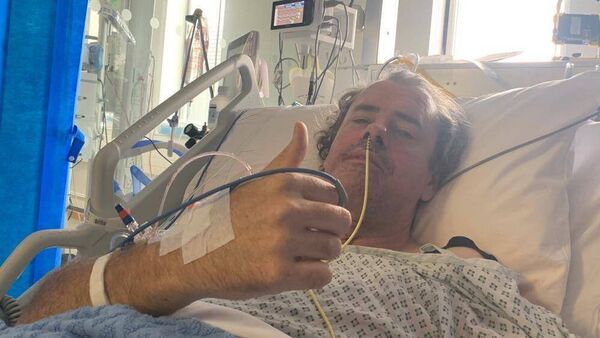
Bob pictured in hospital during his treatment
When Bob Flavin attended a routine appointment with a dental hygienist in January 2024, he did not expect to make a discovery that would change the course of his life.
In his mouth was a strange growth. “The hygienist didn't know what she was looking at either”, he recalls. “She thought I had burned something in my mouth.” Bob had mouth cancer. “Head and neck cancer is what the general term is, but I only had it in the mouth”, he says.
It was a surprise, he says, as he did not display symptoms. Shock was not the only emotion: “I was worried about my family … It's not what I was supposed to leave behind”.
Bob, who lives in Portlaoise with his wife and family, was concerned he would become entirely dependent on family if he were to become “a skinny, very sick man.” He wondered whether his wife would have to look after him.
He continues: “I was more worried about that part of it than actual death. That didn't really bother me.” Bob had no will and no health insurance. “I was too young for any of that kind of stuff”, he says. At the time of diagnosis, he was 52. He is now 54.
He was admitted to St. James’s Hospital in Dublin, where he underwent 11.5 hours of surgery. “Two weeks I was in hospital for, and a week in intensive care”, he says.
The surgery to remove the tumour also removed much of his soft pallet and teeth. Bob had to learn to speak again.
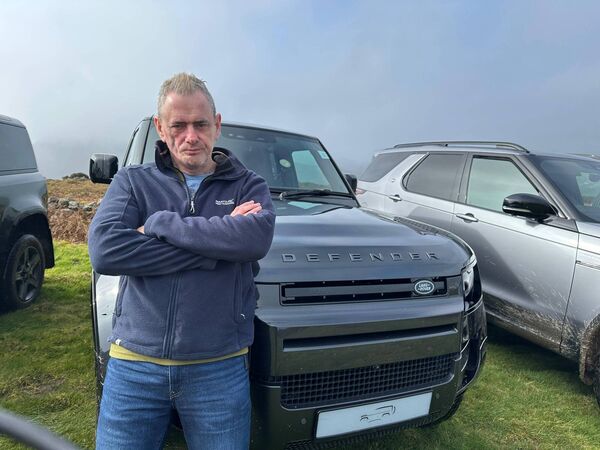
“I started training in speech and language therapy”, he says. “I was told before I started that my voice would come back to relatively normal, maybe a little bit more nasally, in about four months. It's been three years and it still hasn't, I'm still not back where I was.” Losing his voice has affected much of his work. Bob is a journalist who, since 2010, has discussed cars on his YouTube channel ‘BobFlavinVideo’.
“I was one of the first to do car reviews in video”, he says. As of March 2026, he has over 78,000 subscribers.
Although the motivation to produce content is still there, “the reality is that it's very difficult to make videos”, he says.
He notes that, while his loyal fans have stuck with him, he now finds it difficult to attract new viewers: “I can’t expect someone to sit down and watch five minutes of my weird speech pattern.” After surgery, Bob underwent radiotherapy five days a week for six weeks. It was unsuccessful. “I think because my tumour was so close to my eye socket … They couldn't focus on the actual area where it was without damaging my eye.”
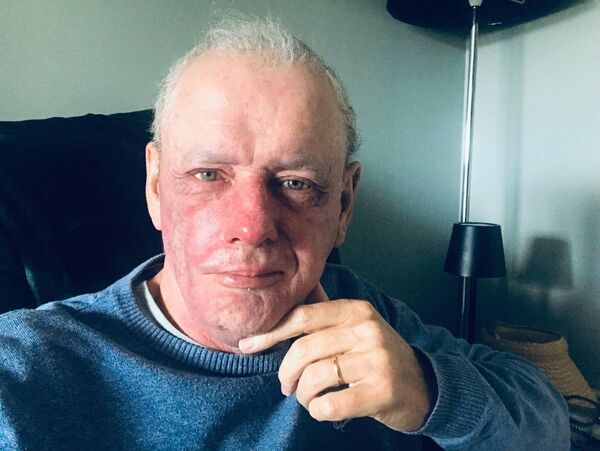
He continues: “[Radiotherapy] is a full-time job. You are going to the hospital every day. For 10 minutes you lie on a bed in a lead-lined room. You're on your own, there's no sound. There are no noises or radio or anyone talking to you … It's weird. It's a weird thing.” Bob’s cancer returned, and this time his consultant told him it was inoperable. “The tumour had spread essentially all across my cheek and into my lower lip and into my eye socket, so it was rampant”, he recalls.
His tumour was the size of a fist. He was signed over to oncology in St James’s Hospital and a Laois-based palliative care team called out to house. Bob made a will; his family prepared for the end.
Then, a miracle. Through a combination of chemotherapy, immunotherapy and steroids, Bob began a rapid turnaround.
“Within 3 weeks I felt wonderful … I had a huge tumour reduction. Everything started to disappear outside and inside my face … And I started feeling better”.
Bob is still undergoing chemotherapy and immunotherapy. His last two scans have been clear of tumour activity. “That doesn't mean it's not there,” he is quick to add. “It just means, visibly, they don't see anything, but it could be sitting in cells or DNA in a small way”.
A piece of skin from Bob’s arm was used to cover the area where the tumour had been removed. Unfortunately, chemotherapy has made that disappear. “There's a hole now where there should be a piece of skin”, says Bob.
This has created issues with eating and drinking. “I can drown from a glass of water because the airway passages open in my mouth”, Bob explains.
“It's possible to choke on food and I have problems swallowing now, but I've gotten used to it”, he continues. “I nearly drowned once in my own blood.” Bob experienced what is sometimes called a ‘herald bleed’, which is a form of bleeding that presages a fatal rupture.
“I lost two litres of blood in 15 minutes in a basin here in the house”, he says.
There were no warning signs. Bob was simply eating when he suddenly tasted iron. “I put my hand up and I went, ‘I’m bleeding’ … It was terrifying, I felt no pain, nothing. I was just bleeding out.” Bob was starting to drown in his own blood. He moved to the sink and let it pour into a basin.
Thankfully, Bob’s wife was at hand: “An ambulance would have taken 20 minutes, but I only live about 5 minutes from Portlaoise Hospital, so we went in her car.” They arrived at A&E. Staff at Portlaoise Hospital stopped the bleeding by closing all the veins in Bob’s mouth.
Bob once again found himself in A&E in January when he had a sudden heart attack. A stent was put in and Bob’s cancer treatment continued after a short break.
“They've saved my life on two occasions”, Bob says of Portlaoise Hospital staff. “They are wonderful, those people”.
Bob is not alone in his diagnosis. Mouth, head and neck cancers affect over 700 people in Ireland each year, according to the Irish Cancer Society.
The National Cancer Registry says it is the seventh most common form of cancer in the country, with the disease claiming the lives of over 200 people annually.
However, Bob says that for three years after his diagnosis, he never once met anyone who had mouth, head and neck cancer: “I'm in oncology … where these people are around, but I don't know who has what. You can't just ask, ‘what are you in for?’”
Bob finds there are sometimes limitations within HSE-led support groups: “We couldn’t talk to each other; we couldn't set up a WhatsApp group. Unless you meet face to face, [people] won’t communicate”.
He finds this isolating: “Not only has my voice been taken, but it’s quite lonely”. Bob believes it is important for cancer patients to meet others like them to discuss medication, therapy and offer advice.
“Patients know an awful lot about the system because we're in it all the time”, he says. “If we can bring that information in through a network of other people who all have the same problems, then that's wonderful.”
Bob has recently met other people like him: “We all talk like me. There's one woman missing her tongue, another man missing his voice box, all those similar cases.”
When Bob experienced his heart attack, he coined a new phrase to describe himself: ‘fierce hard to kill.’ Using this as a guiding mantra, Bob hopes to establish a charity system under that name that will allow others who have cancer to meet, communicate, collaborate and support one another.
Bob has big ambitions for it. “One in two of us will get cancer in Ireland, and when you're dropped into that system, when you have cancer, the information for the first couple of months comes at you so fast and so hard that all you can think is ‘I have cancer.’ You don't think about anything else.”
Bob also believes recovery support is vital: “When you start to recover, you’re ejected out of the system. Little bits of it close off and you never hear from them again … How do you return to normal life when you can't talk, eat properly, or are still sometimes in treatment?”
Bob says it can be very hard to enter back into normal life “without someone ahead of you who has been through [the system]”.
“That's what I want to do”, he says. “That's who I want to be.”
Bob Flavin has set up a GoFundMe to support his treatment and living costs. Donate here: https://www.gofundme.com/f/bob-flavin-fierce-hard-to-kill