Portlaoise hero is honoured in Glasnevin
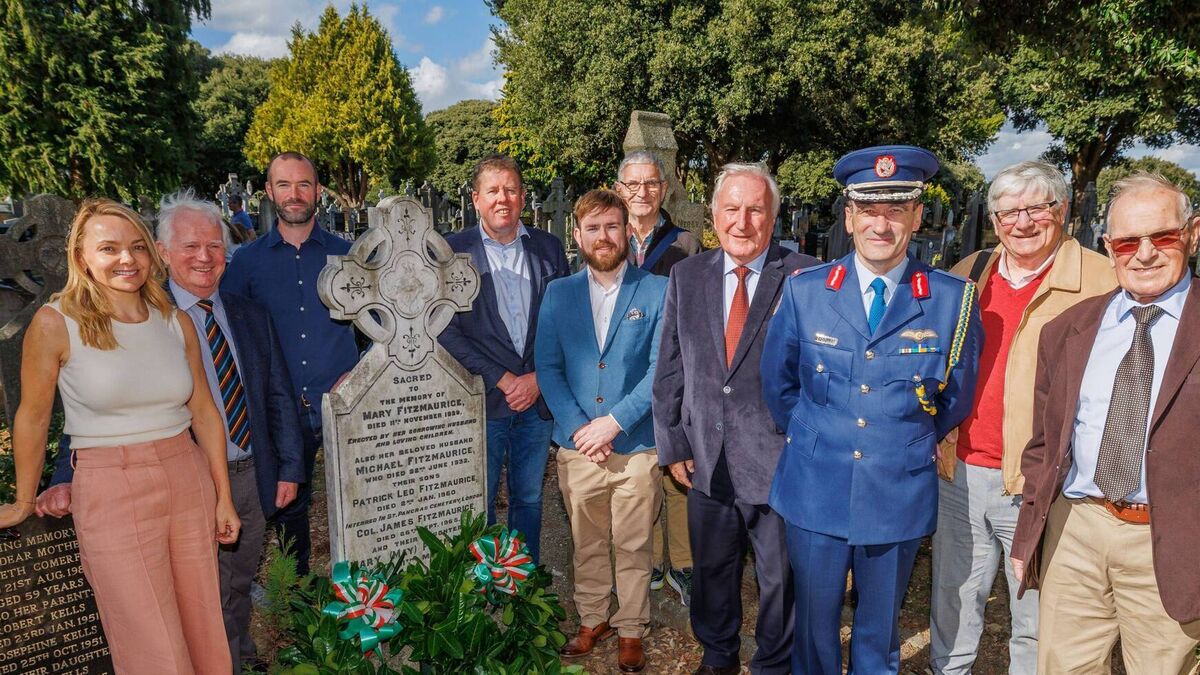
Members of the Fitz 100 committee and the Col. James Fitzmaurice committee in Glasnevin: Louise Fennelly, Maj Gen Ralph James (Retd), Thomas Carolan, LCC Heritage Officer, Alan Phelan, Philip Doody, Liam Byrne, Michael Parsons, Brigadier Gen Rory OConnor, General Officer Commanding, Irish Air Corps, John Mullin and Teddy Fennelly. Photo: Jeff Harvey
A PORTLAOISE man who made international front page news as an aviation pioneer has been honoured at a poignant ceremony in Glasnevin Cemetery.
The tribute to Ireland’s ‘forgotten hero’ Col James Fitzmaurice was organised by Fitz100, the committee leading national and international commemorations for the centenary of the historic 1928 Bremen flight.
The graveside ceremony on 26 September marked the 61st anniversary of the death of Col Fitzmaurice, the Laois airman who helped complete the first successful east-to-west transatlantic flight against all odds.
Retired Major General Ralph James, chairperson of the Fitz100 committee, told the gathering: “James Fitzmaurice was laid to rest here in Glasnevin after a State funeral. In 1928 he was one of the most recognisable, admired and famous men in the world. Unfortunately though, he has become one of Ireland’s forgotten heroes. Fitz100 plans to change that.
“We should all know that an Irishman helped fly the Atlantic the hard way, into the wind, with minimum navigation equipment and proved that what the world thought impossible could be done.”
The Glasnevin ceremony was attended by Brigadier General Rory O’Connor, General Officer Commanding of the Irish Air Corps which Col Fitzmaurice guided through its foundational years, together with representatives from the worlds of aviation and heritage.
The Fitz100 committee will plan and lead a programme of events in Ireland and internationally, working with partner organisations in Germany and Canada.
The next major milestone on the road to the centenary is the Festival of Flight during the week of 12 April 2027 in Portlaoise, where Col Fitzmaurice grew up. The festival programme is being developed with the Fitz100 committee and full details will be announced early next year.
Wreaths were laid at the graveside in Glasnevin, followed by a moment of reflection and a traditional piper’s lament. The wreaths were laid by Brig. Gen. O’Connor, Teddy Fennelly, president of the Col James Fitzmaurice Commemorative Society and Louise Fennelly, secretary of the Fitz100 committee.
At 06.36 on 12 April 1928, the Junkers W33 monoplane Bremen took off from Baldonnel Aerodrome, Dublin. On board were Col Fitzmaurice, then a Commandant in the Irish Air Corps, German pilot Captain Hermann Köhl and the expedition’s backer, Baron Ehrenfried Günther von Hünefeld.
Flying against the prevailing Atlantic headwinds, with no radio, limited navigation equipment and a failing compass, the crew landed on Greenly Island, Canada, 36½ hours later. The east-to-west crossing had been widely considered impossible.
The achievement made front page news around the world. The crew was honoured with a ticker-tape parade in New York and celebrations in cities across North America and Europe, while Col Fitzmaurice was granted the Freedom of the City of Dublin.
Laois Heritage Officer Thomas Carolan said the Fitzmaurice story was one of those rare heritage stories that is local, national and international. He said:
“It begins here in Portlaoise, with a young boy fascinated by the Aldritt monoplane and leads ultimately to one of the great pioneering achievements in aviation history - the first successful east-to-west crossing of the Atlantic.
“The Portlaoise monoplane is currently housed in the old Odlum’s granary building inside the Old Fort in Portlaoise, giving us a tangible connection to the beginning of that story.
“As part of the recently announced funding to develop the site as a multi-functional space, it will provide the opportunity in the future to display the plane and allow a new generation to see that extraordinary piece of local aviation history and, through it, discover Fitzmaurice and the Bremen flight. That is particularly significant as Laois and Ireland prepare to mark the centenary in 2028.”