Strategy to end violence against women and girls ‘making a real difference’
By David Young, Press Association
A Stormont strategy aimed at ending violence against women and girls in Northern Ireland is making a real difference, the region's first and deputy first ministers have said.
Michelle O’Neill and Emma Little-Pengelly said the strategic framework was never going to deliver a short-term fix to what they described as a deep-rooted cultural issue in society.
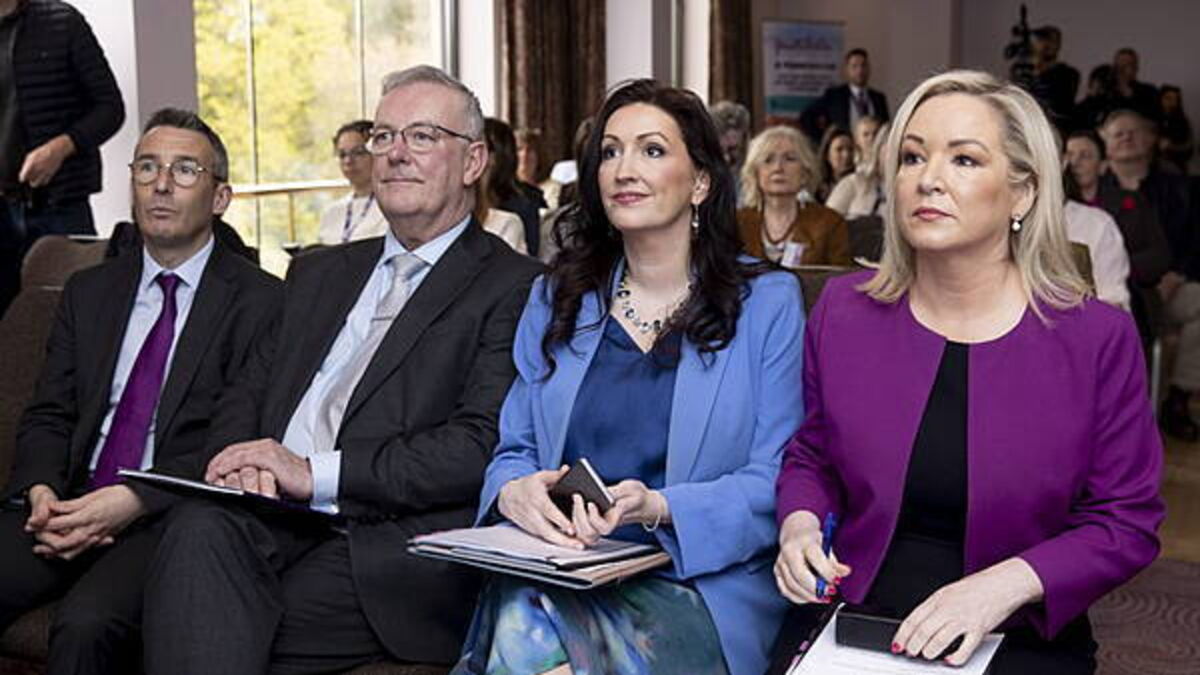
The Stormont leaders were attending the launch of the seven-year strategy’s second delivery plan on Tuesday – an event that heard testimony from organisations involved in work on the ground, such as in schools and youth groups, to challenge misogynist attitudes and tackle gender-based violence, abuse and harm in Northern Ireland.
The leaders were asked to assess the impact of the strategy two years on from its launch, amid public concern about the number of women who continue to die in violence circumstances in Northern Ireland.

Thirty women have been killed since 2020 in the region, seven in the period since the strategy was launched in 2024.
O’Neill, who described violence against women and girls in Northern Ireland as a “scourge” and an “epidemic”, insisted the strategy was a priority for the Executive, with £5 million spent to date and a plan to direct a further £2 million during the second delivery phase, which runs until 2028.
“I think even today, when we reflect on testimony from some of the organisations that have been working in partnership with us, they have reflected to us time and time again about the difference the projects that they’re involved in are making on the ground,” said Northern Ireland's First Minister.
“We have been ourselves out on the ground, in with young people, in community centres, in sports halls. We can see that this is making a difference. But the reality here is I wish there was a switch that we could just flick and that we would solve this problem. That’s not the case.
“We have a cultural change to achieve in our society that’s going to take time. It’s going to take persistence. It’s going to take determination. And it’s going to take partnership. And I know that everybody in that room today who’s helped us to launch this plan, who’ve delivered on the work so far, are determined to do so, and we’re determined to support them in that.”
While acknowledging uncertainty about the overall Stormont budget, O’Neill insisted the £2 million earmarked for the next stage of the strategy was a priority for the Executive Office.

Little-Pengelly said the strategy was “never going to immediately end violence against women and girls”.
She said the plan was focused on the “key principle of prevention”.
“That means starting early,” said the deputy First Minister.
“It means getting in there in terms of schools and youth groups and trying to change, as we’ve said, those attitudes and issues that give rise to those behaviours later in life.
“It’s around supporting those organisations to work with women who are undergoing violence. Currently, it is about supporting those organisations working with families and communities that are having to live through the devastation of losing their loved one.
“Of course, the value in these strategies and actions will be what you don’t see. It’s those that do not get murdered. It’s those that do not live with violence every day. And that is where we want to get to.

“But, of course, that will require – and we said this right from the outset – it will require a long period of sustained investment. And, of course, it isn’t just about that additional money – that additional money is there to support research, to support organisations within the community sector, to support some of those support services – but, of course, it’s more than that. It’s about mainstreaming these key principles and values within our education sector, within the health sector, within so many other additional parts of government.”
Little-Pengelly suggested the response to the conviction of a man last year for harassing her online demonstrated an attitude in society that needed to change.
“I have to say, some of our newspapers etc barely referenced it,” she said.
“You know, so when somebody who’s a deputy First Minister, jointly leading this Executive, has somebody who’s jailed for quite a period of time for a threat to kill, and yet there will be focus on other issues.
“To me, that is an indication that people are still not taking these issues seriously. People do not understand the impact that that has on a woman, on a person, in terms of the fear that people feel about that. And these things have to be taken seriously. It’s one example, I personally experienced it.”
O’Neill said the strategy “means everything” to her.
“I’m a woman, I’m a mummy, I’m a granny, and what I want is that my daughter or my granddaughter grows up in a world where there’s fairness, where they’re safe, where they feel safe, where they don’t have to mind themselves all the time just because of their gender,” she said.
“So this goes to the heart of the kind of society that we want to live in and the kind of society that we want to build. And that’s why this work is so important. I wish it was fast work. But the reality is, it’s not, because you’re changing decades of culture. You’re changing what is really right at the heart of the culture of society.”