Abbeyleix famine film gets Heritage Week premiere
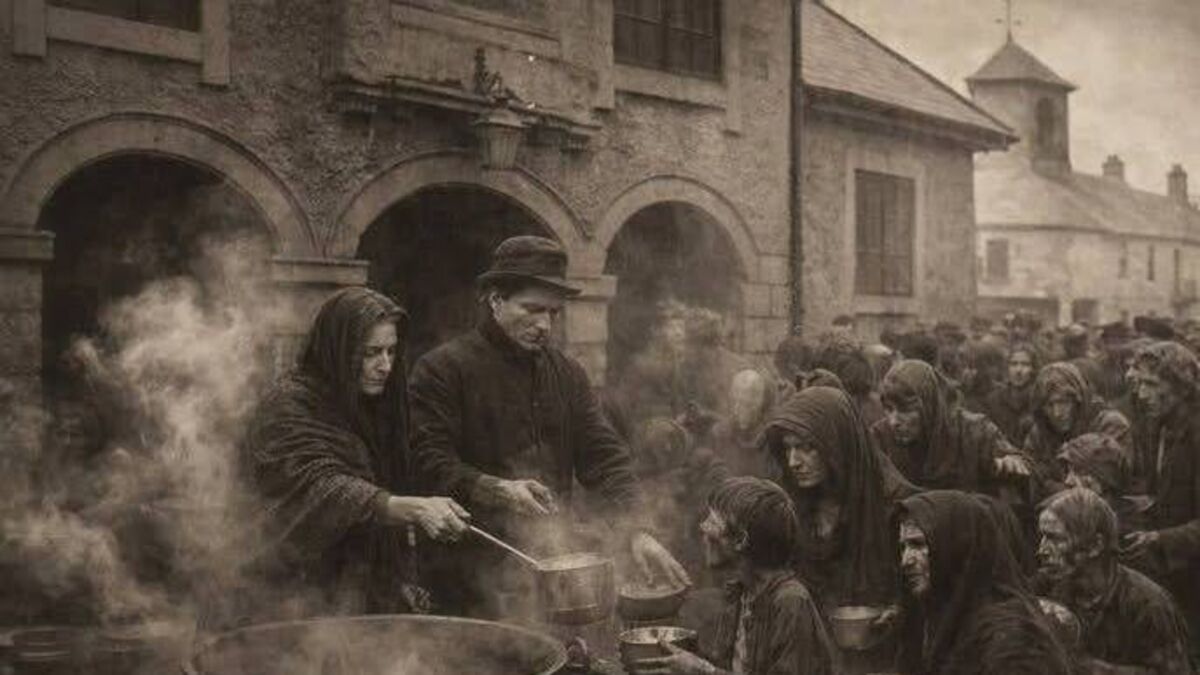
Starving people at the Abbeyleix soup kitchen in 1847, as Lady Emma and Thomas De Vesci serve steaming broth from a single iron pot. Image courtesy of James G. Carroll
A FILM recounting the devastating impact of the Great Famine in Abbeyleix will have its first public screening next weekend.
Filmed earlier this year, will premiere at the Dunamaise Arts Centre, Portlaoise at 7pm on Friday, 21 August, as part of national Heritage Week.
The powerful film tells the story of local endurance during the darkest years of the famine, a story carried in families, memories and landscape.
Describing the premiere as "a major moment", local historian Noel Burke said: “It is not just an Abbeyleix story, it is a Laois story and we are inviting the people of the county to come along and share in it.
“If you care about our heritage, our shared past, or the resilience of the communities who came before us, this film will speak to you. Your presence will help honour that history and ensure it is carried forward with dignity.”
Admission is free but booking is essential, with online booking links available on sites that include the Dunamaise Arts Centre and National Heritage Week. There will be refreshments and a Q&A session after the screening.
Supported by Laois Co Council Heritage Office, the Abbeyleix & District Historical Society commissioned Bailey & Blake Productions Ltd to make the film, which explores the history of the famine from workhouses to emigration, while also highlighting community efforts to maintain famine burial sites and keep the memory of victims alive through commemorative events.
With contributions from many Abbeyleix locals, the film gives a fascinating insight into the inter-generational impact of the Great Hunger – - and the need for people to remember.
Directed by Oliver Fallon, filming began on 8 May and the first scenes recorded by cameraman Martin Blake were at the famine ridges or ‘lazy beds’ in Oldtown, one of the most tangible surviving famine-era features in the county, where so many laboured in desperation from the 1840s onwards.
The film also features landmarks that include the Famine Memorial Stone in the grounds of Abbeyleix Community Nursing Unit, site of the former workhouse and the Gate to Heaven overflow famine burial ground on the Carlow road, which was rediscovered and preserved by Martin Fennelly in the 1980s.
An estimated 2,000 destitute people were buried at the rear of Abbeyleix Workhouse, now the site of the Abbeyleix District Hospital/Community Nursing Unit, where a memorial headstone and limestone seat were erected last May by the Tonduff Cillín Committee.
The film comes at a time when Abbeyleix is campaigning to host the 2027 Irish Famine Commemoration Day, a major national event held annually on the third Sunday in May.
On Irish Famine Commemoration Day next year, Abbeyleix & District Historical Society will stage a re-enactment, with people in period dress walking or cycling high nelly bicycles from Market Square to the hospital, where a prayer service will be held in memory of those who perished from starvation.
The re-enactment will feature an authentic replica of a horse-drawn workhouse cart, which was used to transport people and bodies. The wooden cart will be constructed in conjunction with artist Paddy Carroll and Abbeyleix Men's Shed, led by Johnny Talbot and Michael Moore, with the help of a €1,300 grant from Creative Ireland Laois.
Laois Co Council has unanimously supported a proposal that Abbeyleix host 2027 Irish Famine Commemoration Day. The proposal, which was submitted to culture minister Patrick O’Donovan, was put forward by Cllr Marie Tuohy, who donated €3,000 of her council discretionary fund towards construction of the replica famine workhouse cart.
The cart will travel the same road as 28 young women and girls from Abbeyleix Workhouse, some no more than children, who were sent to Australia in 1848 under the Earl Grey Scheme.
If Abbeyleix is selected to host Irish Famine Commemoration Day next year, the group anticipates that Minister O’Donovan will visit the memorial in the hospital grounds and the Gate to Heaven, as well as the site of Mountmellick workhouse and the Donaghmore Famine Museum.