‘Everyone is worth more than the worst thing they have ever done’ – Sr Helen Prejean
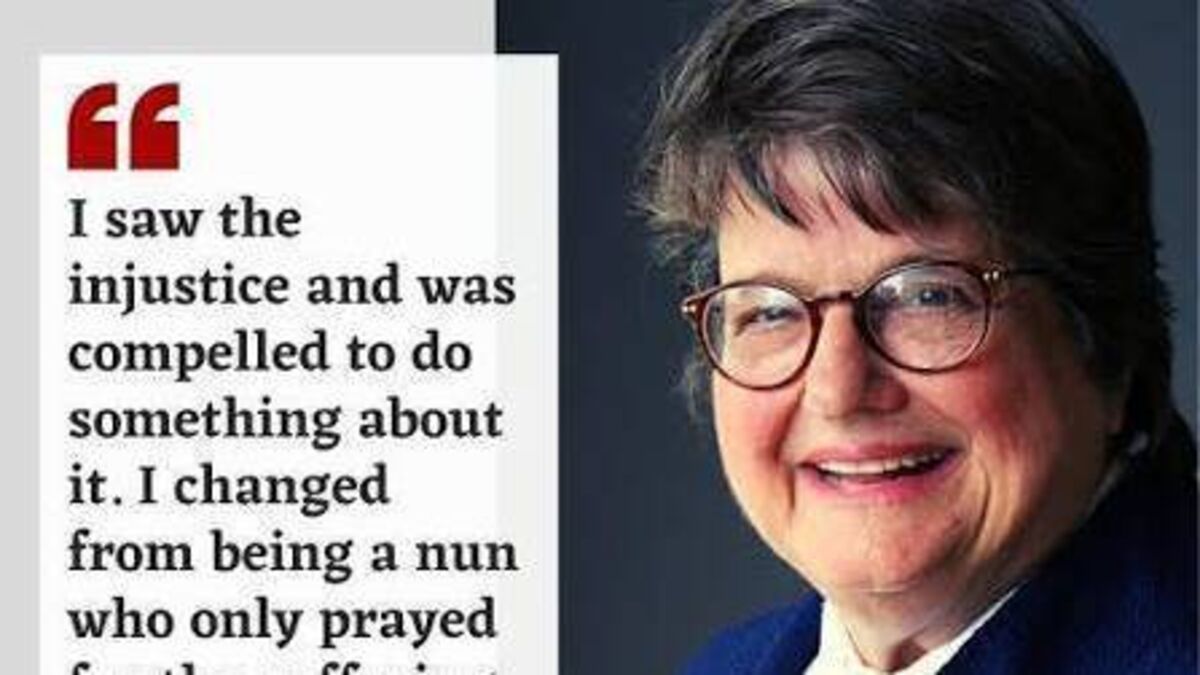
Sr Helen Prejean
MUCH focus these days is on the United States of America. The US hosts this very enjoyable World Cup, true to form the various stadia are exuberant and very big in every sense of the word. The recent celebration of the 250th anniversary of its foundation celebrated the extraordinary contribution the United States has made over many decades. These are turbulent times for the people of the United States. Perhaps one of its greatest assets is not its president, but the US born pope Leo XIV. Leader of 1.4 billion Catholics.
Pope Leo is universally acclaimed as a global moral leader, whose voice brings balance and inclusion in a world that is polarised and deeply conflicted. Leo deliberately visited the tiny island of Lampedusa on 4 July. There, he visited a people seeking new beginnings and opportunity. Thousands of children and women have died crossing the Mediterranean in the hope of a new tomorrow. Pope Leo reminds us that together we are stronger and that the dignity of human life is a sacred and a fundamental gift for every Christian. Another wonderful Christian leader from the United States is Sr Helen Prejean.
Sr Helen Prejean was awarded an honorary doctor of laws by Trinity College on Friday 19 June. The degree is one of Trinity’s highest honours, conferred in recognition of exceptional contributions to society. Katie Taylor, Sharon Shannon, Colm Tóibín and baroness Helena Kennedy were also honoured at the awards ceremony. Sr Helen is a member of the Congregation of the Sisters of St Joseph and is based in New Orleans, Louisiana. Naturally, the presentation to Katie Taylor was the one that captured the headlines in the media. I hadn’t noticed that Sr Helen was also honoured until a friend alerted me. The acclaimed movie Dead Man Walking is based on the autobiographical book by Sr Helen. It follows her relationship with Matthew Poncelet (Sean Penn), a man on death row convicted of the brutal rape and murder of two teenagers. As his execution approaches, Sister Helen (played by Susan Sarandon) becomes his spiritual advisor, accompanying him through his final weeks while also encountering the overwhelming grief of the victims' families.
She has compassion for the murderer, but her compassion never excuses his crimes. She treats him with dignity and before his execution he can reclaim that dignity and take full responsibility for his crimes. He apologises to the father of one of his victims and asks for forgiveness before sitting in the electric chair. This was the first time Sr Helen had acted as spiritual advisor to a prisoner on death row. After accompanying five more prisoners to their deaths and having come to know their families and some of the families of their victims, she wrote: “I joined the national movement to awaken the American people to the moral wrongness and futility of authorising government officials to set about killing (legally of course) citizens they consider the worst of the worst.” In its official citation, Trinity praised her as: "One of the most influential people in the last 50 years working in opposition to the death penalty and the promotion of the interests and dignity of prisoners." Her lifelong work was described as “an uncompromising defence of life and justice." Her ministry has had a profound impact on public debate about capital punishment in the United States and internationally.
She is totally opposed to the death penalty as she firmly believes that every human person possesses an invaluable dignity even after committing terrible crimes. She appealed to pope John Paul II in 2005 to strengthen the Church’s compromised stance on the death penalty. The Church allowed for state killing in cases of absolute necessity, but “it remained silent on the affront to the human dignity of criminals executed after being rendered completely defenceless.”.
She argued that it is not only the innocent who have dignity. She pointed out the inconsistency of pro-life Catholics who readily condemned abortion but supported the death penalty. One of the greatest moments in her campaigning, giving it a seismic boost, happened on 2 August 2018 when pope Francis declared that the death penalty is unacceptable in all cases. It is, he said: “An attack on the inviolability and dignity of the person and contrary to the gospel of Jesus.” Sr Helen was also convinced of the innocence of some condemned prisoners. She wrote a book in 2005 The Death of Innocence: An Eyewitness Account of Wrongful Executions, which tells the story of two people, Dobie Gillis and Joseph O’Dell, who were victims of a dreadful miscarriage of justice. There was considerable doubt about the guilty verdict, but nevertheless they were given a lethal injection.
Seeing the plight of murder victims’ families, Sr Helen founded a support group called Survive. The families’ grief and anger, their suffering and pain following the violent deaths of their loved ones have touched her deeply. But she has often felt overwhelmed by the families’ ability to forgive rather than seek an ‘eye-for-an-eye’ retribution. Such experiences have deepened her conviction about the wrongness of the death penalty.
A sentence of life behind bars is preferable to the death sentence. I was surprised to learn that the cost of pursuing a death sentence far outweighs the cost of a life behind bars. There is also, she points out, the “evermore evident cruelty of botched executions in the so-called humane method of lethal injections.” Sr Helen has consistently highlighted the gross injustice built into the whole criminal justice system in the United States. There is a glaring racial disparity that prioritises the death penalty for the murder of white people, while devaluing the much more frequent murder of people of colour. White people are rarely sentenced to death for the murder of black people.
Sr Helen’s core philosophy is that “everyone is worth more than the worst thing they have ever done.” She continues to be a powerful advocate for criminal justice reform, even though she is now well into her 80s. She is deeply committed to the Christian faith and to prayer every day. What authentic witness to the gospel values she promotes. May we all be fuelled with a spirit of kindness and compassion in our daily lives.