Seriously ill Laois girl (10) waits over an hour for ambulance
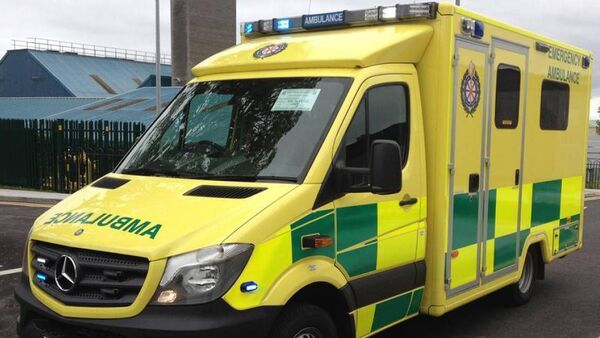
File image
A 10-YEAR-OLD Laois girl with a serious medical condition had to wait more than an hour for an ambulance at the weekend.
An ambulance was eventually deployed from Athy as none was available in Laois, during the urgent medical emergency.
The child was detained in hospital overnight, following an extremely worrying ordeal for her family.
Independent councillor Aidan Mullins from Portarlington said he was contacted today by the girl’s mother, who was deeply concerned about the ambulance’s slow response time.
He said the situation could place lives at risk and is ‘just not acceptable, in a country with plenty of resources where our health services should come first’.
Cllr Mullins said on social media: ‘I was contacted today by a parent in Portarlington, whose 10-year-old daughter urgently required the assistance of an ambulance over the weekend because of a serious medical condition.
‘There were no ambulances available in Laois at the time. The nearest one was in Athy and it took an hour and ten minutes for it to arrive.
‘The operator stayed on the line with the parent the entire time and was exceptional in her duties.
‘When the emergency services eventually arrived they treated the child, who was detained in hospital overnight and discharged the next day.'
Cllr Mullins added: ‘This is not a criticism of the medical staff who are doing their best. However, the slow response time, which could place lives at risk, is just not acceptable in a country with plenty of resources where our health services should come first.
‘We badly need additional resources to upgrade and improve our hard pressed ambulance services in Laois, which are under severe pressure.’
Ongoing delays in local ambulance response times have been repeatedly criticised in recent years since the introduction of the ‘dynamic deployment’ system, which can see Laois ambulances regularly deployed to surrounding counties and even as far afield as Cork and Waterford.
Speaking in the Dáil last October, Independent Laois TD Brian Stanley said that dynamic deployment means that ambulances based in Laois ‘can be sent anywhere’.
He said an ambulance crew can do 600km in a shift and are sometimes turned back within a couple of minutes of their destination.
Deputy Stanley said: ‘Recently in Laois, there was only one crew and one ambulance on call. When the crew clocked in, they were immediately sent to Wexford. Meanwhile, Laois was left without an ambulance. On Monday and Tuesday nights, there is only one ambulance available.
‘An ambulance can take up two hours to arrive at locations within the county - it might not even arrive at all - because of this. That is no fault of the staff.
In reply, Taoiseach Micheál Martin told the Dáil: ‘The issue of dynamic deployment has arisen since the configuration was developed many years ago. On the surface, I can instinctively empathise with the deputy's point because it does mean that ambulances are travelling long distances. We have to respond to this in an evidence-based way.
‘I will talk to the Minister for Health and have further engagement with the National Ambulance Service and the professionals involved as to what is the optimal deployment of staff and ambulances and what is the best way to do it.’
Mr Martin added: ‘We should be open to examining what is the optimal way to deploy the resources. Many professionals would say that what they are doing is the optimal way to do it. The deputy is articulating a different perspective. I respect the points he is making, but I do think we probably need to look at this in a more evidence-based way. Perhaps the Oireachtas Joint Committee on Health could examine it in more detail.
‘The professionalisation of the service and the development of two dedicated helicopter emergency medical services, for example, represents a significant expansion that is enhancing our response.'
Mr Martin said that ‘the key responder’, an EMT or a first responder who is qualified and professional, can save lives.
He said: ‘There have been a lot of very positive reforms and a great deal of significant investment in the service in the past number of years. There have been issues and, from time to time, members have raised the matter to which Deputy Stanley refers.’
When contacted for comment this week, the National Ambulance Service (NAS) said that, while it could not comment on any individual case, it regretted that any service user should have ‘a negative experience’.
The organisation said in a statement: ‘The NAS works to deliver the highest standard of care for people using NAS services. NAS operates a nationally integrated deployment model that dispatches the nearest available ambulance to the most urgent calls, regardless of county boundaries.
‘All 999/112 calls received for emergency medical assistance are prioritised using an internationally recognised system that triages calls based on clinical priority, which range from life-threatening- cardiac or respiratory arrest to minor illness or injury.
‘This means that, during particularly busy periods, lower-acuity calls may wait longer for an ambulance. The National Emergency Operations Centre (NEOC) is the command and coordination hub of the NAS. It is staffed by Emergency Medical Controllers, Emergency Dispatchers, Clinical Nurse Managers, Control Supervisors and Control Managers.’
The NAS described the Clinical Hub as a specialised service in the NEOC, designed to provide advanced clinical support during the triage and management of emergency and urgent calls.
The statement said: ‘The Clinical Hub is staffed by experienced healthcare professionals such as specialist paramedics, doctors and nurses, who work in tandem with emergency call takers and dispatchers. Its core aim is to improve patient care by ensuring that each caller receives the most appropriate clinical pathway based on their needs.’
The NAS added that it remains ‘acutely aware of the unique challenges associated with delivering emergency services in rural areas and recognises the additional resources required to meet these needs’.
It said: ‘The NAS is undergoing a significant transformation programme to enhance service delivery, optimise resources and expand its role in providing alternative and community-based care. Since 2022, additional investment has seen the NAS base budget increase by 41% (an additional €83 million) to €285 million in 2025.
‘Over the same period, staffing levels have increased by 28%, with an additional 588 whole-time equivalent staff, bringing total NAS staffing to 2,655 WTE. Capital investment of €126 million has also been made in fleet replacement and expansion to support these developments.’
The issue was again raised by Deputy Stanley in the Dáil on Wednesday 22 April. See more in the next edition of the , in shops and online on Tuesday 28 April.