In the blood - White family 'holy trinity' of healthcare
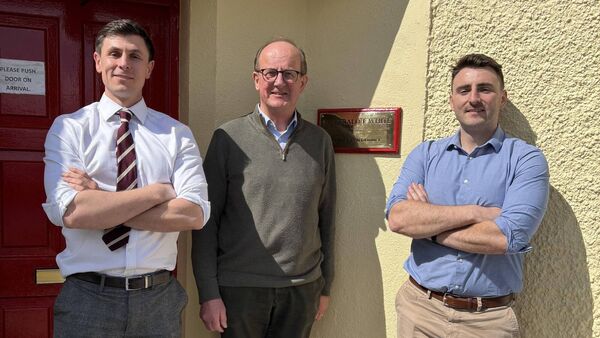
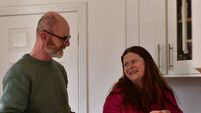
Drs William, Gerald and Edward White outside their medical practice in Portlaoise
In the heart of Portlaoise, Dr Gerald White has operated his practice for the better part of 30 years out of a small, homely yellow building.
(Oh, and by the way, it’s Dr Gerald, not Gerard, despite what Google Maps might tell you. “I'm also White with an ‘i’, that's another one”, he jokes.)
Sitting in his consultation room on a Monday afternoon, the light of an unseasonably warm spring day shining in through the window, he is joined by his two colleagues, his sons Drs William (36) and Edward (33) White.
This is an intergenerational affair as Gerald’s practice has bucked a trend; rather than seeking work abroad, two of his sons have decided to come back home to practice medicine.
Indeed, medicine is in the blood. “I come from a medical background”, says Gerald.
“My mother was a GP; my uncle was a GP”, he continues. “My great-grandfather was a surgeon in India, and my grandfather was born there. I have granduncles [in medicine], one was a master at Holles Street, another was in charge of Carlow Mental Asylum [now known as St. Dympna's Hospital].”
Two of Gerald’s siblings also went into medicine; his brother, Prof. Martin White, is a consultant in neonatology and practices between Crumlin and The Coombe, while his sister, Prof. Eileen O’Keefe, works in the Department of Health Sciences at Boston University.
In a family almost defined by its association with medicine, does Gerald feel his destiny was a pre-determined one? “Yeah, it was medicine or veterinary. I don’t know if the animal kingdom was saved or humanity was saved”, he says.
Gerald has four sons and a daughter, and all of whom are in – you guessed it – medicine. Drs William and Edward have joined him at his practice, while Drs Gerald Jr. and Matthew practice in Toronto, Canada and Darwin, Australia, respectively. His daughter, Sarah, is currently in her final year of studies.
“Someone said to me one day that it smacks of a lack of imagination”, Gerald jokes.
Did William and Edward feel the calling early on, too? “Yeah, I never really had a chance, I suppose”, says William. “I think we were just exposed to it so early and we grew up with it”, he continues.
When William and Edward were children, their dad operated his practice out of their home in Cavan. “[We] would have had on-call rooms in the house, so people would have come into the house after hours”, says William.
“We would be out playing and people [would be] coming in with small emergencies and things like that, so you'd have it literally in the house ... It was always around us, really.” As William moved through his education, his interest in medicine solidified: “The interest in science and the exposure to people day to day just appealed to me.”
Edward’s journey was a little different: “I was set on being a vet until about the age of 16”, he says. “Then I did a mini-med course in my Transition Year up in the Royal College of Surgeons [RCSI], which completely changed my mind set … Medicine was always there in the background, but that week-long course was what made me want to do it”.
William and his brother Matthew studied at RCSI like their father, while Edward and Gerald Jr. studied at Semmelweis University in Budapest, Hungary.
Why did Edward choose Budapest? “It seemed like a great opportunity to go to a great university and a beautiful city for a couple of years and expand the horizons a little bit further.” Edward met his partner while studying at Semmelweis. They are expecting their first child this year – perhaps another doctor is on the way. After his studies, Edward returned to Ireland to become a GP.
After William finished studying at RCSI he interned for a time in Beaumont. This was followed by two years of surgical training in Waterford and Galway in orthopaedics. “I decided that wasn't for me, so I went to New Zealand for what I thought was going to be one year, and that turned out to be a little bit longer.” William spent three years in New Zealand training in anaesthetics. Much like Edward, he later returned to Ireland to start the GP training scheme.
Doctors have been leaving Ireland in droves for decades. According to a 2025 study published in the , up to 30 per cent of recently trained GPs in Ireland emigrate to Australia, New Zealand, Canada or the UK annually. An article published on the RTÉ website stated that, in 2022 alone, 442 Irish doctors were granted temporary work visas for Australia.
In 2018, Dr Niamh Humphries, a senior lecturer at the RCSI Graduate School of Healthcare Management, interviewed 40 Irish hospital doctors who had moved to Australia over the previous decade. Dr Humphries found that they had moved partly due to “understaffed and overstretched workplaces” where “extreme ways of working” had become normalised.
Says William: “Our brother in Darwin sees two patients an hour … We'd probably see a good few more than that, just because we have to get through the demand, but there's a lot to be said for being at home.” William and Edward have challenged the expected narrative not only by coming back to Ireland, but also by setting up in a rural practice as young professionals.
According to a policy document released in 2025 by the Irish College of GPs (ICGP), rural Ireland has 40 fewer GPs per 100,000 people than urban areas. The document also notes that many rural GPs are older and nearing retirement, which will leave a vacuum in rural healthcare.
Why did the brothers choose Portlaoise? “This seemed like the obvious choice at the end of the day,” says Edward, “because Portlaoise has a lot to offer in town and outside town as well”.
He continues: “People are extremely grateful for even the smallest things you can do, and I think that's what keeps a lot of Irish GPs here, the fact that we have very good communities, especially in more rural places.” Gerald moved his practice to Portlaoise from Cavan in 1996. An Abbeyleix native, he was eager to return home. “I know virtually 99 per cent of people's names”, he says. “I’d know them on arrival … And that is most unusual nowadays”. He adds that it is this very sense of community that “keeps [him] going”.
William adds: “On the worst day, there's always one little thing – one ‘thank you’ or one phone call – that kind of picks you up.” He says that doing something simple, like phoning a patient to let them know an x-ray is ready, makes him feel a little lighter: “The person's been sitting at home for three weeks worrying about it, and they're delighted to get the call.” William has been in the Portlaoise practice for three years, Edward two. They are now building their own relationships with local patients.
“When we get good news, it's great,” he says, “when it's bad news, it hits us a bit harder as it goes along. It matters to us.” This smaller, community-based approach also helps them identify which doctor is best suited to a particular patient.
Says William: “Patients have access to whoever they want, or one of us will see someone and say, ‘well, maybe Edward would be better at that, so maybe come back to him tomorrow and he'll be able to sort that out for you.’” William and Edward can also draw from their father’s knowledge of a patient’s medical history: “We'll have a chat at the end of the day about someone that maybe Dad might have known for 20 years, [it helps if] we're trying to figure something out”, says William.
It is also a huge help, he says, to be able to draw on his father’s knowledge of someone’s family history, which can help in diagnosing hereditary illnesses: “These things colour a picture, you know?” Many of the older women that Gerald has seen over the years would remember his mother, Dr Maguire, who practiced out of both Abbeyleix and Portlaoise. She helped deliver many of their children.
While William concedes that this personalised approach is probably better for a patient, the way things are run in larger practices – where someone may see a different doctor each time they visit – is simply down to demand and volume: “It's just whoever's available will take the patient … that's how they have to run it to survive.”
The pressures of the healthcare system are felt in a myriad ways. “The thing we find is that there's a lot of pressure put on the GP side of things”, says William. Sometimes hospitals will offload patients onto GPs: “It comes from the HSE quite a lot, who come back and say, ‘the GP can sort this out’.
“There's a perception that we're maybe not as busy as some of the hospital people. Our hours are more structured, I suppose, compared to the consultants, but we are a bit like flat out during the day … Not to complain about hospitals, they’re under pressure as well. We appreciate that.”
William would like to see more technology implemented across the HSE. “In a lot of the hospitals, we still get carbon copies of paper … in a profession where handwriting is famously bad, we're still trying to pick apart these people's signatures, but we're seeing electronic letters more and more now.”
In New Zealand, everything was computerised, says William, and a GP’s notes were accessible to other medical teams. This streamlined a patient’s healthcare, as they would not have to repeat tests when moving between departments. This often does not happen in the HSE, where a visit to another department could entail starting the process of testing again.
“The HSE is not exactly an efficient system”, says Gerald. “We're constantly battling for the patients to try get them here, there and everywhere.” Edward notes that while the ICGP aims to increase the number of GPs going into training (1,311 medical graduates applied for GP training in 2024, an increase on all previous years), the challenge will be to retain them.
Ultimately, Gerald considers it an honour that his patients let them into their lives “in such a personal, intimate place”.
William agrees: “The trust is very much appreciated”, he says. “We just do our best to maintain it and keep it going.”