Engineer’s talk on canal works in Vicarstown draws crowd of 80-plus
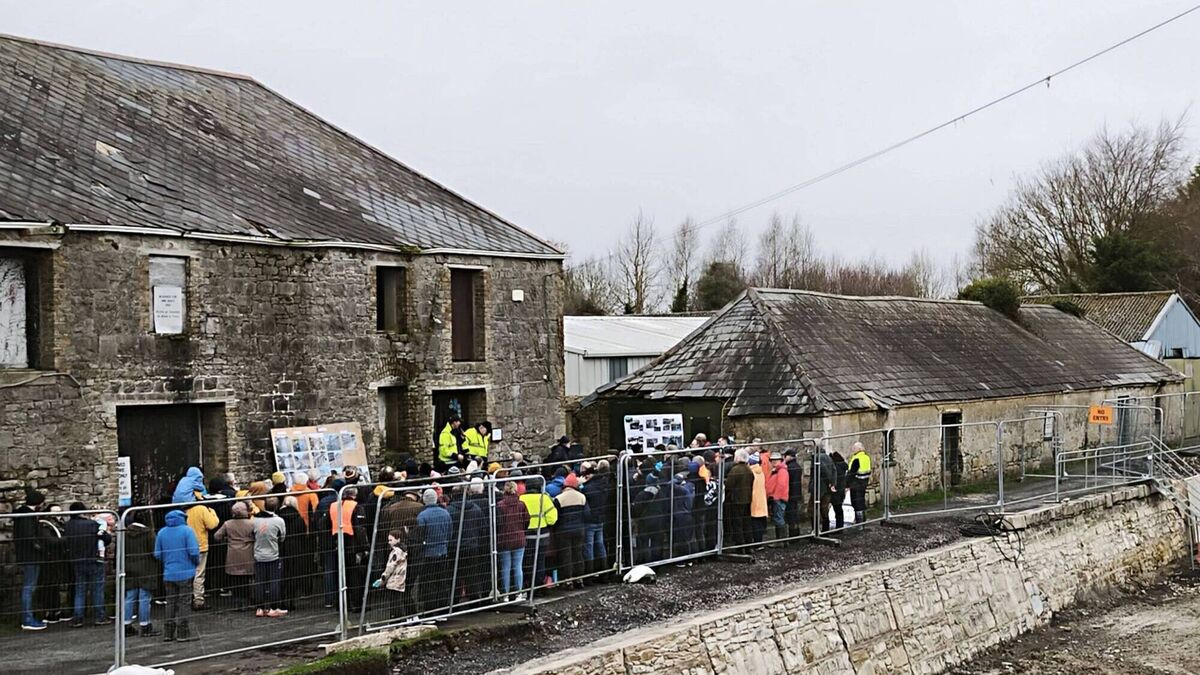
Around 80 locals and waterways enthusiasts attended the talk at Vicarstown Photo: Stan Henderson
MAJOR essential refurbishment works are being undertaken on the Barrow Line at Vicarstown harbour by Waterways Ireland, which includes rebuilding of over 130 metres of stone quay walls and extensive masonry repairs to improve the structural integrity and to enhance local amenities.
The process involved a 250-metre stretch either side of Vicarstown bridge on the Grand Canal being dried out for construction to take place.
As the work reached completion, a crowd of over 80 people turned up on Sunday 1 March to hear an information talk by Waterways Ireland’s senior engineer Gerard Bayley.
This gave locals and waterways enthusiasts a chance to see the half-kilometre stretch of the canal without any water in it and to see the extensive works that have been carried out.
Before the talk began shortly after 11am, senior engineer with Waterways Ireland, Gerard Bayley spoke to the Laois Nationalist about the restoration works.
Taking up the story behind the works, he said: “The work was required because the quay walls in Vicarstown were in very poor condition. They were built originally in the 1790s, so they’re over 200 years old. There were several stretches of about 20 metres each along the quay walls that had to be taken down and replaced. The last 20 metres by the bridge had fallen down in 2006, which is the last time that the water was taken out of the canal.
“It was replaced with a timber jetty. On the eastern side of the canal, no wall existed for most of living memory, no one on our crews or retired staff remembers a wall in that location, so it fell down maybe 50 or 60 years ago, we’re not sure when. It had a timber jetty, too, but again it wasn’t original.
“We took on this project this winter to restore the quay walls on foot of a very successful project in Monasterevin two years ago. We have rebuilt all of the walls that were unstable or had fallen down, which includes 60 metres at Turley’s side and 40 metres here at Crean’s side.
‘‘Also, alongside the old building on Crean’s side, where the towpath is very narrow, there is a 40-metre stretch where there was never a quay wall. Towpath requirements are increasing with houses being built and farm entrances. Over the decades, bits of iron and timber were beaten into the ground to hold back the bank, so we have formalised this now. We built a concrete wall which will be finished with a nice timber capping to blend with the scenic views.
‘‘We didn’t do this in stone because in another 200 years, if the canal is dried again, people might think that it was original, so now they’ll know that it is from a different era.” When asked about the process of taking the water out and when the dams are due to be removed, Gerard said that taking the water out is a process in itself. He said: “We have clay dams at either end of the canal, 500 metres apart. Each dam contains around 1,200 tonnes of clay. The clay is all from the canals from local areas, so we are not bringing in any invasive species. The clay will be returned to where we took it from when we are finished, we’re only borrowing it.
“Following this, we engaged with our colleagues in the fisheries and they came in and electro-fished the entire stretch of canal and took all of the fish out of the canal and returned them to the other side of the dams. Once that process has been undertaken, we can then use the pumps to pump the water out, also to the other sides of the dams, so no fish were harmed.” Gerard said that over the 500-metre stretch of canal there were 11,000 fish taken from the water. While laughing, he added that: “If a fisherman or fisherwoman is saying that they can’t catch fish along the canal, then they are the problem.” Also, he said that there were approximately 3,000,000 litres of water pumped out to dry the 500-metre stretch of canal and that the entire process only began in the last week of November, adding that the first stone wasn’t laid until the first week of January.
At the information talk, Gerard and his team had photographs from different stages of the process on show for people to view. He explained the whole process and commented that there are generally only about 15 people at these talks. He also answered questions from the large gathering.
The canal will be rewetted and opened to boat traffic shortly after St Patrick’s day. However, the crew will continue to work on landscape projects along the banks for a number of weeks following that.