Medical detective drama sparks important conversations at Dunamaise Arts Centre
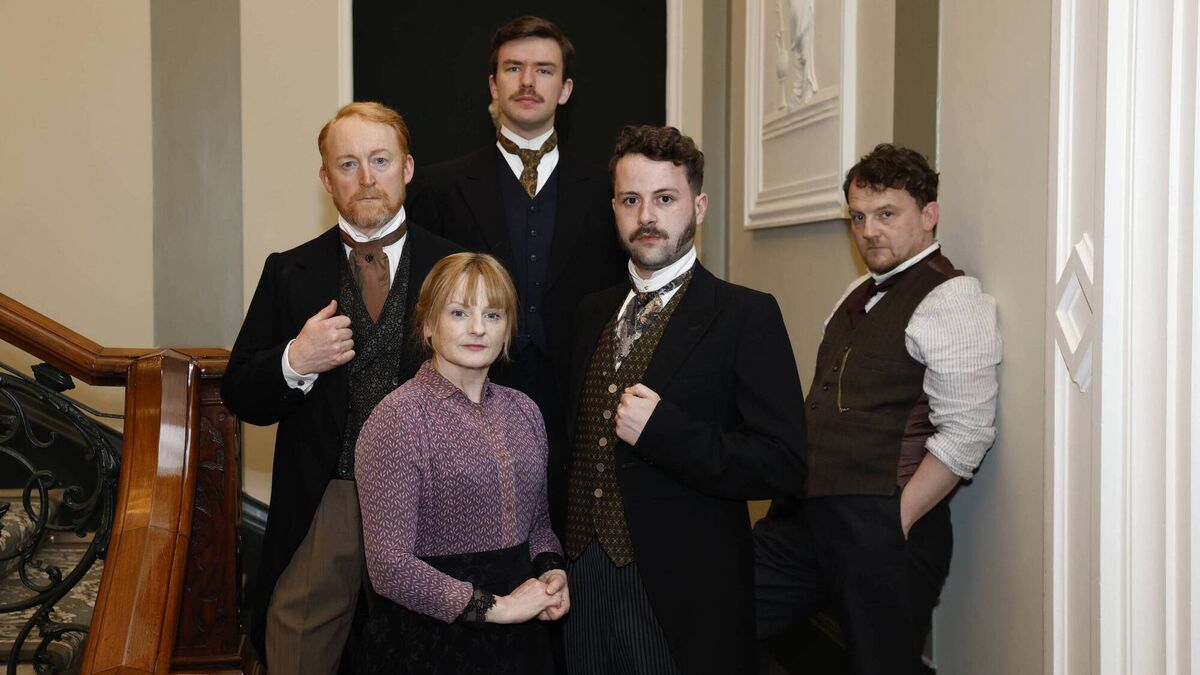
The cast of Miasma by Colin Murphy: Karl Quinn, Peter Rothwell, Jack Gavin, Robbie O'Connor and Niamh McGrath. Photo by Conor O'Mearain.
, a ‘gripping’ new medical detective story, was staged at the Dunamaise Arts Centre in Portlaoise on Wednesday 29 April.
Written by playwright and journalist Colin Murphy and presented by Verdant Productions, follows Dr John Snow and his fight against the cholera pandemic in 1840s–50s London.
Dr Snow challenged medical orthodoxy and laid the foundations of modern epidemiology and data science.
Directed by Samantha Cade, who has worked extensively across stage, TV and film, the play highlights themes of relevance to third-level students of medicine, science, social science and history.
is currently on a tour of medical institutions, giving its audience a unique insight into venues rarely open to the public, including the Royal College of Physicians, the Royal Irish Academy, the Royal College of Surgeons and Tallaght University Hospital.
The cast includes established actors Jack Gavin, Niamh McGrath, Robbie O’Connor, Karl Quinn, and Peter Rothwell.
Tackling themes of trust in science, groupthink, and political corruption, Murphy’s medical detective story illuminates key challenges still at the heart of science and public health today.
Many of these issues were discussed in a post-show Q&A session, moderated by journalist David Monaghan.
The panel included Dr Douglas Hamilton, consultant in public health with the HSE; Dr Ida Milne, social historian of illness; and Phoebe O’Leary, a research fellow on the project and an academic specialising in theatre and epidemics.
Phoebe spoke about the importance of theatre in helping people process major events: “[Theatre] is communal, something we take part in together, and which we enjoy together … It's great then for sparking a conversation, because we've all experienced it together … It's a a great medium, I think, for really encouraging people to discuss, to engage with art and science in a different way.”
Dr Milne discussed the lessons we can learn from history: “When COVID happened, that there was quite a lot of knowledge gap in certain sectors, not amongst the people who'd be here on the stage, but maybe amongst politicians and other people in the public field who were dealing and managing the pandemic”, she said.
She continued: “When my book [ ] came out in 2018, people told me that nobody's really going to be all that interested because there's never going to be a pandemic like that again.
“Everybody but me and the public health doctors said it's not a question of if, but when it’s going to happen again, and nature has kind of a habit of biting us or teaching us a lesson when medicine gets most cocky.
“What I really found early in the pandemic in March 2020 … You could see mistake after mistake being made … I was saying, ‘hold on, you need to mask the janitors in the hospitals, the people who are there who are bringing in people, you need to mask the workers in the shops, even if the masks are rudimentary’”.
Dr Hamilton spoke about the importance of good communications in healthcare: “I think messaging is probably the most important part really of health, and to get that message right, but of course you have to first of all get the right message.
“You have to get the facts, and I think John Snow showed that really well. You study, scientifically, the issues … you use evidence of the past – the evidence that is there, the collected evidence, globally, from international research … When it came to COVID, when there wasn't enough of that, you had to use some basic principles.”
The play depicted Dr John Snow going from door to door speaking to people affected by the cholera outbreak, to gather data to assist his research. This aligns with Dr Hamilton’s own experiences during COVID: “We were in our own cars, driving around, we were out there with particularly badly affected communities like the Traveller communities, the Roma community, and knocking on doors with masks on and giving out information in different languages and trying to get people to really understand the basics about the spread of COVID.”
Social inequalities are exacerbated during health crises. This idea featured heavily in the play and was discussed by the panel. Said Dr Milne: “For part of my PhD, I looked at the 2009 Irish pandemic preparedness plan, which, of course, was focused on influenza, because that's what had caused the major pandemics for the last century … I was really shocked when I looked at that plan [and saw] they don't really mention social inequalities.
“They mention medical inequalities with heart disease, obesity, but not the idea of overcrowded housing, the digital divide, the literacy divide.” Dr Milne mentioned her international colleague, Dr Sven-Erik Mamelund, who has done extensive work to ensure social inequalities are addressed in European pandemic preparedness plans.
“This is the kind of work that medical humanities people can do [to] make real significant change”, said Dr Milne.
As the conversation drew to a close before a brief audience Q&A, Dr Hamilton stressed that, in an age of mis-and-disinformation, it is “crucial to always get your information from sources that we know are correct and we can trust.”
is funded by the Taighde Éireann – Research Ireland Discover Programme.