‘Robin Hood’ of Laois features in new book
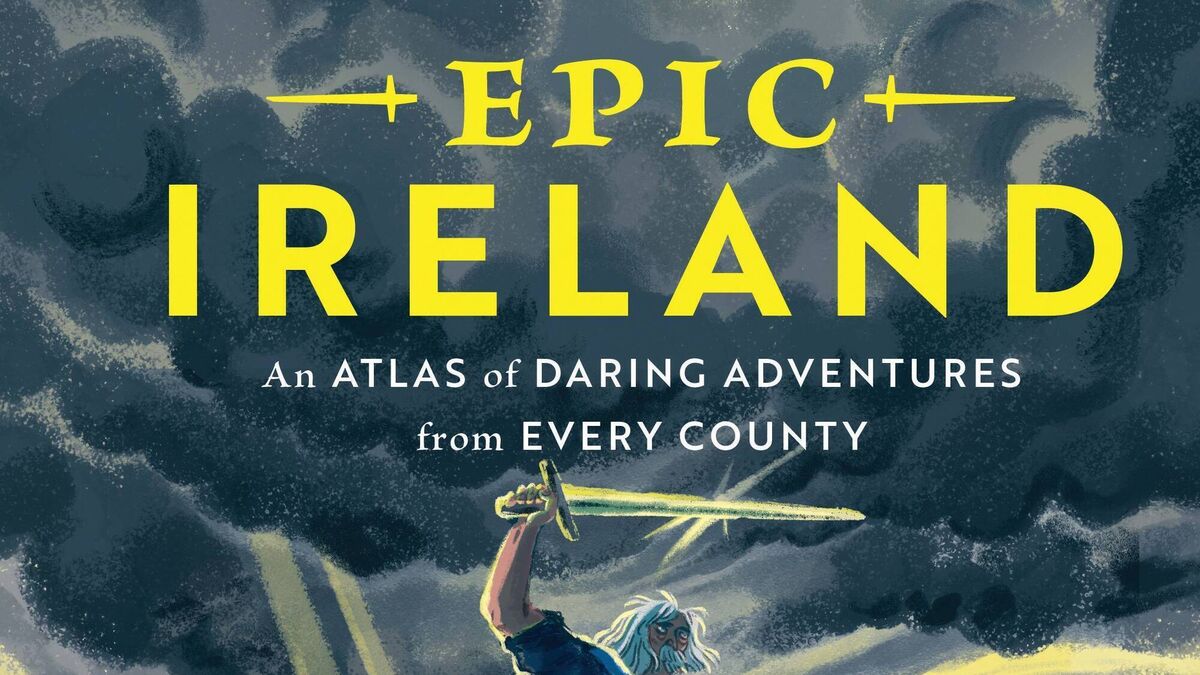
A section of the cover of the new book, published on 22 October
A NOTORIOUS highwayman who gave his name to one of the most popular pubs in Portlaoise features in a new collection of children’s stories, launched in time for Halloween.
The well-known tale of Jeremiah Grant, who became a Robin Hood-type hero in the early 1800s, is included in ‘Epic Ireland, An Atlas of Daring Adventures from Every County’, written by primary school teacher Kieran Fanning.
Illustrated by Alice Guidi, the beautiful hardback also features tales of other legendary heroes, villains, pirates and saints from all 32 counties.
From saints such as Brigid of Kildare to sinners that include William Burke of Tyrone, the book’s epic cast of characters range from Ireland’s first hangwoman to a tennis star who became a murderer.
One of the most famous hangings in Ireland was that of Jeremiah Grant, whose story is recalled in fascinating memorabilia at the pub that bears his name on Main Street, Portlaoise, opposite the site where Grant was hanged in 1816. The gallows beside the original Maryborough Gaol, on the corner of Church Street and Main Street, witnessed many public executions in the early 19th century.
In retelling Grant’s story in ‘Epic Ireland’, the author points out that one of the most notorious hangings in Laois and nationally was that of famed highwayman Jeremiah Grant, from Moyne in Tipperary. Born in 1785, Grant began life as a tenant farmer but, during a row with his landlord, he fired a warning shot from a pistol and was accused of attempted murder. To avoid prison and a possible death sentence, he went on the run and fell into a life of crime to support his wife and children.
The author says: ‘He was much loved among the ordinary people, who saw him as a type of Robin Hood - a wronged man fighting the authorities to provide for his family. People hid him in their barns and cheered when he outwitted the police, though they usually tracked him down eventually.
‘He was captured many times and had a remarkable ability to escape from prison. In 1815, he escaped from jail in Clonmel in a manner worthy of a Hollywood movie.
‘He managed to get a file smuggled into his cell to saw through the iron bars of his window. The only problem was that the window was in full view of the jailer’s office. Jeremiah Grant needed a distraction.
‘His cellmates were only too happy to help, because an escape for Grant also meant escape for them. One of them rubbed the shackles around his ankles, until his skin was so sore that the doctor ordered that his shackles be removed. While the bolts were being noisily hammered out in the jailer’s office, Grant began filing furiously at the iron bars in his window.
‘Each day, another cellmate would complain about his sore ankles until his shackles were removed. Each time, Grant used the noise and distraction of the shackles being removed to file another window bar, until all that held them in place was a tiny scrap of metal.
‘Then, a riot was organised in the nearby women’s wing of the prison. While all the guards from the men’s wing rushed to assist, Grant and his cellmates snapped the bars free and escaped.’
Grant was recaptured a few months later, put on trial and sentenced to death. He was remanded in the old Maryborough Gaol, which is now the Dunamaise Arts Centre, to await his execution. He had escaped from here before, by having a skeleton key smuggled into his cell inside a cooked herring. This time, however, security was at its highest, with extra guards posted to keep eyes on the infamous Captain Grant.
Jeremiah accepted that escape was impossible. Not one for sitting idle, he decided to make the most of his last days by dictating his life story to a ‘young gentleman’ who scribbled his words on paper.
On 13 August 1816, Jeremiah Grant was led to the gallows, with a large crowd supporting him. Though he was a highwayman, he was always proud that he’d never killed anyone and perhaps this was one reason he became a folk hero. Even his final words before the noose tightened around his neck were remarkably humble: “I forgive the world and hope the world will forgive me. May Almighty God pardon my sins.”
After his death, his story lived on through publication of ‘The Life and Adventures of Jeremiah Grant’, the book he had dictated during his final days in prison.
Author Kieran Fanning says that he has always been fascinated by Irish stories and legends. A writer and teacher from Navan, Co Meath, he holds a master’s degree in children’s literature. His other books include ‘Enchanted Ireland, Haunted Ireland’ (Gill Books) and ‘Irish Fairy Tales, Myths and Legends’ (Scholastic).
The book features maps and facts about all the locations and people mentioned, as well as a full page artwork to illustrate each story. The book’s illustrator Alice Guidi is an Italian artist based in Milan, with a particular interest in folklore, mythology and ancient history.
Published by Gill, ‘Epic Ireland’ costs €24.99 and is available in bookstores from 22 October.