Memory Room is proposed for Laois
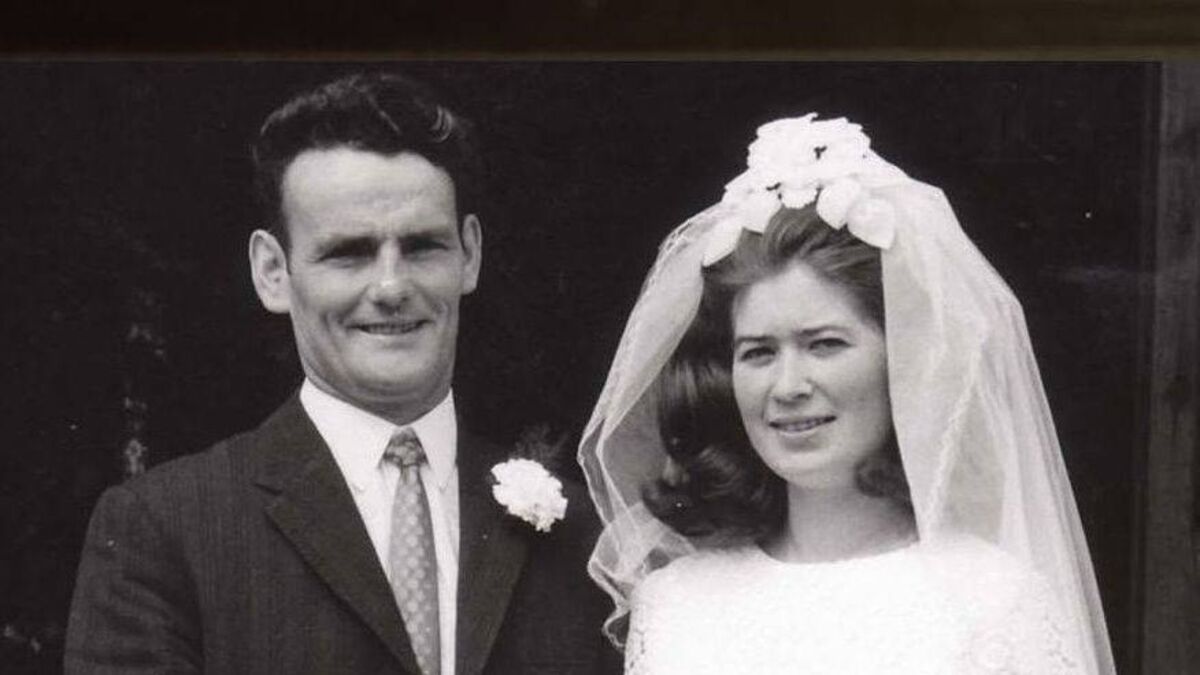
Joan Coady from Abbeyleix, now aged 81, pictured with her late husband Seán Dunne on their wedding day. The photograph is among treasured family memorabilia preserved by local historian Noel Burke and photographer James G. Carroll, as they begin to plan a Memory Room for the county
A MEMORY Room for family photographs, letters and other treasured heirlooms has been proposed for Laois.
The proposal submitted to Laois Co Council’s Heritage Office is for the creation of a dedicated space in a public building, where older people can deposit personal pictures, letters, diaries, medals and other memorabilia that they fear may be discarded or lost after their deaths.
The idea put forward on behalf of Abbeyleix & District Historical Society (ADHS) has already received a positive response from county councillors, who were contacted this morning by the society’s chairperson Noel Burke.
Noel told the : ‘I’ve contacted all Laois county councillors today about creating a Memory Room in a public building, a safe place for families to deposit photographs, letters and small heritage items.
‘I told them that, with their help, Laois could become the first county in Ireland to create a Memory Room. The idea is already gaining traction with a number of councillors responding positively, some within one hour.’
The proposed Memory Room would be housed within an existing public building in Abbeyleix or Portlaoise, with oversight by the ADHS and shared access for the wider community.
The idea gained momentum at the weekend, when Noel highlighted the story of 81-year-old Joan Dunne (née Coady) from Abbeyleix, whose uncle James Coady was only 18 when he died in France during World War I.
Joan has a treasured collection of framed photographs and childhood keepsakes but, as she is the last in her family, she feared that the unique collection might not be protected by future generations.
Joan’s friends, including local historian Noel and photographer James Carroll, promised to document her life story and to preserve her photographs, assuring her that the family memories would be saved for posterity.
Explaining the impetus for the Memory Room, Noel said: ‘Joan’s concerns echo those of many older residents, especially people without children or those who identify themselves as the final generation of their bloodline.
'Recent local cases show what can happen without such a facility, including one elderly farmer from Abbeyleix whose personal photographs and centuries of memorabilia were dumped at the Kyletalesha landfill site near Portlaoise, after his estate was settled.’
The Society already has some separate boxes of personal property from deceased members of the community, ready to be submitted to a Memory Room.
One practical question is how an older person can ensure their photographs and personal items are safely lodged in the Memory Room. If the person signs a Heritage Executor Instruction and has a solicitor place it on file, this formally records their wishes.
When their estate is being handled, the solicitor can point to this document and confirm that the person intended their prized possessions to be deposited in the Memory Room. This is a simple, dignified way for people to make their intentions known, even if they cannot lodge the items themselves.
As far as Noel is aware, no county in Ireland currently provides a Memory Room or similar service. He said: ‘If approved, Laois would become the first county to lead with a compassionate, community-centred heritage initiative and others could follow.
‘We are asking councillors simply to support the identification of a suitable room within an existing public building. This initiative requires minimal cost, no continuous staffing requirements and uses expertise already available within the ADHS.
‘It is a small, practical step with enormous social value, protecting personal heritage, supporting older residents and allowing Laois to lead the country with the first facility of its kind. With councillors’ backing, this project can move forward quickly and deliver a meaningful, compassionate service for the people of Laois.’
The Memory Room is envisaged as a safe, private sanctuary where people can place personal heritage items, not for public display or exhibition but simply for respectful custodianship, offering protection for stories that might otherwise be lost forever. It would be a place for the memorabilia of those whose family lines are ending, or whose heirs may not be able to take on the responsibility of preserving the past.
If approved, the Memory Room would move into its planning phase later this year, including securing a suitable space in the community and exploring funding options to make it a reality.
Noel commented: ‘No one’s life story should be thrown away. No one’s memories should be lost. Abbeyleix can lead the way in protecting them. There will soon be a place where their story can live on.’
When he highlighted Joan’s story on 4 July, Noel observed that some narratives live quietly in a family for more than a century, held in old photographs, whispered in memories and carried in the heart of the one person left who still remembers.
One such story is that of Lance Corporal James Coady, a teenager from Clonking, Abbeyleix, who left in 1914 to serve with the Leinster Regiment in World War I and never came home. His memory is lovingly kept alive by his niece Joan, who asked that her uncle’s story be written and shared so that it would never be lost.
‘This is for her,’ said Noel, as he wrote: ‘James grew up in a close, hardworking family in Clonking, the son of Michael and Bridget Coady and brother to Jack Coady, who would later become Joan’s father.
‘James was still only a teenager when the world changed. In 1914, when World War I broke out, young men across Abbeyleix and Maryborough (now Portlaoise) stepped forward. Some joined out of duty, some out of adventure and some because their friends were going. James was one of them.
‘He enlisted in the 4th Battalion, Leinster Regiment, proud to serve, proud to represent his home place and proud to stand with the other Irish lads who answered the call. His parents watched him go with a mixture of pride and fear, the same feeling carried in every Irish home that sent a son to war.
‘James was sent to France, where the Leinster Regiment faced the brutal reality of trench warfare. Mud, cold, exhaustion and constant danger were part of daily life. For a boy of 18, it must have been overwhelming, yet he endured it with quiet determination.
‘In early 1916, James fell ill. Fever swept through the trenches as mercilessly as any enemy attack. He was taken to the medical facilities near Hazebrouck but, despite every effort, he passed away aged 18 on 11 April, 1916.
‘In July 1917, at a ceremony in Abbeyleix House, Certificates of Honour were presented to the families of local men who had served. Michael accepted his late son’s certificate, a moment of pride and heartbreak intertwined.
‘James rests today in Hazebrouck Communal Cemetery in France, amid rows of white headstones marking the graves of lost soldiers His grave is tended with dignity and care, ensuring his name will never fade. The Coady family also received a King George V memorial scroll, a symbol of honour for the sacrifice James made.
‘James died long before Joan was born, yet she grew up with his photograph, his name, his certificates and the quiet reverence with which her father Jack spoke of him. Joan has lived her life without children of her own and she has carried the fear that her family’s photographs and memories might someday be forgotten. But they won’t be. Now that this story is written and shared, James’s life will be remembered by the whole community.’
Adding a poignant message for the niece James never knew, Noel wrote: ‘Joan, this is your uncle’s story - and yours. You have kept his memory alive for a lifetime. You have honoured him with love, pride, and devotion. And now, his story will live on through your friends, your community and everyone who reads this tribute. His name lives on. Because of you.’